

Community
vampish
F
SIDNEY BOLKOSKY
Special to the Jewish News
S
er ra ion o
the city's
trz-centennial.
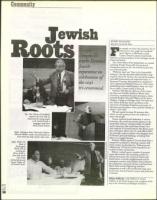
Top: Tom Tannis of Southfield
expresses his view that its
important for young people
to be involved with a
synagogue and learn
about Jewish history.
Right: Michigan State University Professor
Kenneth Waltzer makes his presentation as
local historian Judy Cantor takes notes.
Right: Walter M
Stark of
Huntington
Woods tells of
working for
Henry For as,
from left, Jacob
and Linda
Schwarzberg and
Stuart Trager, all
of Detroit, listen.
r.
env people can recite the impressive list of
Detroit Jews who might be considered
heroic figures as effortlessly as Judy
Cantor, Detroit's premier local Jewish
historian and past president of the Michigan Jewish
Historical Society.
Part of the theme of her presentation on a panel
initiating Temple Emanu-El's Detroit Jewish
Perspectives series on Jan. 20 revolved around this
sort of Jewish pride.
While her topic was "Jews in the Automobile
Industry," she also discussed influential Jews rang-
ing from David W. Simons, the turn-of-the-century
successful businessman and respected citizen, to
Raymond Zussman, the posthumous recipient of
the Congressional Medal of Honor in 1944. From
philanthropists to baseball players, from war veter-
ans to rabbis, Cantor knows of them all.
Professor Fred Pearson, director of the Center
for Peace and Conflict Studies at Wayne Stare
University, moderated the panel discussion, which
included Professor Kenneth Waltzer of the James
Madison College at Michigan State University and
me, Sidney Bolkosky, history professor at the
University of Michigan-Dearborn and author of
Harmony and Dissonance: Voices ofJewish Identity in
Detroit, 1914-1967.
We each spoke for about 30 minutes, after
which we took questions from the audience of
about 100 people.
Cantor outlined Jewish leadership in various
businesses. She noted that Jewish presence in the
automobile industry remained small, but signifi-
candy important. She cited Meyer Prentis, one-
time treasurer of General Motors; Abe Barret, presi-
dent of Hudson Motor Car Co.; and Albert Kahn,
the seminally creative architect who designed some
of Detroit's principal buildings, including Ford
Motor Co.'s largest factories.
Professor Waltzer spoke of Detroit Jewry from a
comparative perspective. Painting a picture with
broad strokes, he described the "fashioning and
refashioning" of Detroit's Jewish population as it
evolved toward a community.
Waltzer touched upon a number of socioeco-
nomic phenomena: the increasing number of
African Americans who moved to Detroit and
found homes in Jewish neighborhoods and the
consequent tensions and problems that produced;
the exodus-like movement of Jews north and west;
Henry Ford and his frightening Dearborn
Independent as well as the inordinately large num-
ber of racist and anti-Semitic orators and politicians
in Detroit.
Sidney Bolkosky is the William E. Stirton
Professor in the Social Sciences and a professor of his-
tor.), at the University of Michigan-Dearborn.
2/9
2001
38