

Op inion
Editorials are posted and archived on JN Online:
www.d.etroitjewishnews.corn
Seeking Unity
N
o matter who wins next week's election for
prime minister of Israel, his first task must
be the creation of a national unity govern-
ment. The last year and a half has made it
p4infully clear a government that excludes major ele-
ments of Israeli political life cannot succeed.
Israel is not like the United States where George
W. Bush can form an effective administration with-
out seating Democrats in his inner coun-
cils. Even though less than half the voters
supported Bush, the traditions of our
democracy and the backing of a Congress
led by Republicans assure his policies will get a fair
hearing.
Not so in Israel, where the 120-member parlia-
ment, Knesset, will remain exactly as it was before
the election; i.e. bitterly divided, not just on the
peace process but also on every major topic of
national importance.
Ehud Barak made a mistake when he was elected
prime minister 20 months ago at the head of the
One Israel ticket, an amalgam of Labor and two
smaller left-leaning parties. Honorably intent on get-
ting troops out of Lebanon and trying to write a
peace deal with the Palestinians, Barak spurned the
idea of a national unity government that would have
given Likud ministries and a strong rightist voice in
the cabinet. Instead Barak formed a coalition gov-
ernment with the backing of the religious parties —
and the coalition collapsed as soon as one of those
parties, Shas, with 17 Knesset seats, decided there •
was more for it to gain by toppling the administra-
tion than by supporting it.
President Bush's playbook in presenting himself as
a sensible and principled unifier for a nation
weary of partisan division. Sharon's lead is primar-
ily based on his promise to be tougher in peace
talks with the Palestinians, but his promises as a
domestic unifier are welcome to many.
Barak hasn't ruled out such a government but
he has repeatedly said he himself would not serve
in a Sharon administration. That smacks
of putting personal interest ahead of
national interest, hardly an admirable
position for a national leader.
The absence of a unity government
clearly. weakened Barak in his negotiations with
Palestinian leader Yasser Arafat. If Barak had had
to work out positions in advance with the Likud
leadership, he could have gone to the bargaining
table at Camp David with a strong mandate that
might have convinced Arafat that the "red lines"
beyond which he would not go were real. It
probably wouldn't have been acceptable to
Arafat, but then, what reasonable plan is?
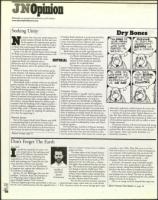
Dry Bones
rn-le IMAGE oF 4,11
ovR PRIME
MINISTER,
wHo WAS
FcR CE -to
RESIGN,
EDITORIAL
Sharons Success
Part of the reason Likud's Ariel Sharon now holds
a commanding lead in pre-election surveys is his
promise to create a unity government with Labor as a
partner. Given his track record as a divisive force in
the country, he seems to be borrowing a page from
Related coverage: page 25
rib VoTE
UJH6THER (AO
WANT HIM TO
RePR6SEKTT
us OR NOT
ts SAD
FoR SARNI
AND SADDER
FOR 11-1E
CoUNITIRk{.
Common Causes
A unity government is equally vital for address-
ing Israel's internal problems, such as high rates
of poverty and unemployment. So long as a
coalition government, like Barak's, is beholden
to Shas, it cannot move to resolve the religious-
secular splits that bedevil the country. Nor can it
make sensible budgetary decisions in crucial areas
like education when the price for parliamentary sta-
bility is handing out blank checks for the pet pro-
jects of splinter parties. The vital long-term need to
bring the level of government services to Arab Israeli
communities up to the level of those for the Jewish
Israeli ones must be addressed by Labor and Likud
working together.
Two months ago, members of Knesset decided,
irresponsibly, that they were not willing to stand for
election at the same time that they forced an elec-
tion for prime minister. That means the current par-
liamentary stalemates could continue for more than
two years. Unity governments don't assure success
— witness the inaction under Yitzhak Shamir in the
late '80s. But without a drastic effort now, policy
choices will be forced by the extremists at either end
of the political spectrum and will not reflect a main-
stream consensus.
The prime minister will have his hands full trying
to build agreement within a cabinet that includes his
political foes. But surely that is better than the pre-
sent impasse. Unit; isn't merely desirable, it is
absolutely necessary. ❑
Don't Forget The Earth
I
2/2
2001
4
32
New York
does not support strong action to address
t would be wonderful to write a col-
global warming.
umn simply about the traditions and
The latest report of the United Nations-
joys of Tu b'Shevat, the Jewish New
sponsored Intergovernmental Panel on Cli-
Year of the Trees, celebrating the
mate Change predicts that Earth's average
magnificence of the trees that grace our
temperature could rise by as much as 10.4
earth and praising our Creator for the deli-
degrees over the next 100 years — 60 per-
cious diversity of fruits trees provide.
cent higher than predicted less than six years
But I cannot. For the very fruitfulness
ago. This would be the most rapid tempera-
of creation that inspires the celebration of
ture change in the last 10,000 years. The
MA RK X.
Tu b'Shevat is endangered.
warming
is caused primarily by burning fos-
JA COBS
On Jan. 23, the Washington Post ran this
sil
fuels,
which
releases carbon dioxide into
Special
headline: "Scientists Issue Dire Prediction
the atmosphere; trapping the warmth of the
Com mentary
On Warming: Faster Climate Shift Por-
sun like a blanket around the earth.
tends Global Calamity This Century."
For the first time last summer, scientists
These are frightening words, particularly in the con-
observed open water, rather than ice, at the North
text of a new administration that has signaled that it
Pole. Insurance claims for storm damage grew expo-
nentially in the 1990s. West Nile virus is in New
York and malaria is in Toronto. These developments
are consistent with predictions that sea levels will
rise, polar ice caps melt, tropical diseases migrate,
whole species and ecosystems vanish — and
droughts, floods and severe storms increase.
As always, the poorest, most vulnerable people
will be hurt the most, particularly in the world's
poorest nations, where little shields billions of peo-
ple from the direct effects of weather and climate.
This is the most severe crisis humankind faces,
and perhaps has ever faced. The way we produce
most of our energy is undermining the very inhabit-
ability of Earth, as we know it.
This is an energy crisis far beyond the scope con-
DON'T FORGET THE. EARTH on page 34