
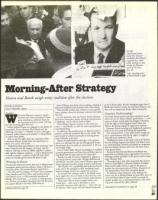

Far left:
Likud party leader
and prime minister
candidate Ariel Sharon
is greeted by a rabbi
while visiting an open
market in Netanya,
north of Tel Aviv,
Jan. 25.
Left: A peeling poster
of Ehud Barak in Jafa
Morning-After Strategy
Sharon and Barak weigh unity coalition after the election.
DAVID LANDAU
Jewish Telegraphic Agency
Jerusalem
IV
ith Ariel. Sharon's victory in Israel's
election next week considered a fore-
gone conclusion, political observers
are focusing instead on what will hap-
pen the morning after the vote.
Leftist political forces are resigned to the defeat of
incumbent Prime Minister Ehud Barak and are
debating two issues — whether to join a unity gov-
ernment under Sharon and whether to dump Barak
as Labor Party leader.
And on the far right, there are suspicions that a
victorious Sharon would ditch the hard-liners in
favor of a union with Labor.
Underlying these speculations is the consensus view
that, however wide his margin of victory may be,
Sharon will find it hard to cobble together a sustain-
able rightist-religious coalition — just as Barak found
it hard to sustain a coalition of the left and center
when his broader government fell apart in July.
Winning In Knesset
The Knesset arithmetic shows that even if religious and
immigrant parties join his coalition, Sharon will have a
minority of the 120-member Knesset behind him.
He will need the support of Center Party members
Dan Meridor and Roni Milo, and brothers David
and Maxim Levy — still nominally members of
Barak's One Israel bloc — to create a working major-
ity. All four are onetime Likudniks who left the party
to support Barak in the May 1999 election.
Related editorial: page 32
Even if Sharon does form such a coalition, keeping it
stable and satisfied could consume most of his energy.
Most pundits predict that without a unity govern-
ment, another round of elections is almost inevitable
this year.
In new elections, they say, former Prime Minister
Binyamin Netanyahu almost certainly would mount
a challenge, and would be hard to defeat.
This explains Sharon's interest in the unity sce-
nario — and Barak's as well, his recent protestations
notwithstanding.
In addition, the pundits point to Sharon's need to
present a relatively moderate face to the world. This
goal would be aided enormously by having promi-
nent Laborites at his side.
Sharon himself speaks as though a unity govern-
ment is in the bag. He says he will approach Barak
the moment the exit polls are announced, at 10 p.m.
on Tuesday night.
Even if Labor balks, Sharon has pledged to establish
a narrow government and leave key portfolios open so
that Barak and his party can join at a later date.
Plainly, the talk of unity is designed to appeal to
the many centrist voters who, though disillusioned
with Barak, are still a little wary of Sharon, given the
former general's hawkish image at home and abroad.
The Likud's own unpublished polls indicate that the
unity card is the strongest in their candidate's hand,
and his strategic advisers are urging him to play it.
To counter this strategy, some in the Barak camp
have urged their man to make it clear that he is not
prepared to enter a unity government under Sharon.
They argue that as long as people believe the
Likud line — that unity is the likely or even
inevitable outcome of the election -- they will vote
for Sharon, believing he will have Barak beside him
at the Cabinet table. Barak's strategists argue that if
Barak can convince voters he won't join Sharon, they
may end up supporting Barak, albeit reluctantly.
Unspoken Understanding?
This week, Barak issued a statement saying he would
never serve in an 'Aswan-Tehran" government — a ref-
erence to threats voiced earlier by Avigdor Lieberman
of the far-right to bomb Egypt's Aswan Dam and
Tehran, the Iranian capital, in response to violence.
However, Barak's wording only heightened suspicions
both in his own camp and among the opposition.
One interpretation is that while Labor would not
sit in a government with the far right, it might sit
with the more moderate Likud.
Clarifications later in the. week went a bit further,
but the feeling lingered that Barak and Sharon have
an understanding, whether articulated or unspoken,
that the election winner will invite the loser into a
unity government.
Seasoned observers say Sharon and Barak may
move fast to outflank Labor opponents of unity by
offering a senior portfolio to the party's senior states-
man, Shimon Peres.
The reasoning is that other peaceniks like Justice
Minister Yossi Beilin or Knesset Speaker Avraham
Burg could hardly call for a split in the party to
protest the unity government if Peres, champion of
the peacemakers, were there alongside Barak.
In addition, these observers note, perhaps the
surest way for a defeated Barak to head off a move to
oust him from Labor's helm would be to lead his
people quickly into a unity government, with some
top posts reserved for Labor officials.
GRASSROOTS CAMPAIGN on page 28
j
2/2
2001
25