

This Week
DO'WN TO THE
:404054WaWiESIEStr41040-a''.-IfEE,'EaKirAtir Xf4MAPZMKMSAIZZEWilFMZIXa:%:Sl
With Israeli elections looming, Barak and Sharon's plans emerge.
GIL SEDAN
Jewish Telegraphic Agency
Jerusalem
IV
ith less than two weeks left until elec-
tions for prime minister, Israelis may
have a general idea of what the two
candidates would offer the Palestinians
in peace talks, but they are short on specifics.
Through leaks from the candidates' campaigns and
comments from some of their closest aides, a fairly
detailed picture emerges of the negotiating stances of
Israeli Prime Minister Ehud Barak and opposition
leader Ariel Sharon.
Settlements
In campaign speeches, Sharon promises not to dis-
mantle any settlements.
However, Likud Knesset Member Reuven Rivlin, a
close associate of Sharon's, said this week that
Sharon's position may in fact be more nuanced. In
future negotiations, "Sharon will not provoke the
Palestinians on the settlements," Rivlin said.
"Sharon will not freeze the settlements, but he will
not allow 'provocative settlements,"' Rivlin said. "It
is not clear whether he will allow expansion of exist-
ing settlements."
Rivlin didn't explain how he defines "provocative"
settlements.
Barak has agreed to consider American proposals
that call for the dismantling of far-flung settlements,
but wants to annex large settlement blocs in the
West Bank close to Israel's 1967 borders that include
some 80 percent of the settler population.
According to his deputy minister of defense,
Ephraim Sneh, Barak will not dismantle any settle-
ments if the negotiations become deadlocked,
despite calls to this effect from supporters.
Jerusalem
Barak said Tuesday that Israeli and Palestinian nego-
tiators must find a way to share administration of
Jerusalem's Old City and its holy sites, "so there
won't be -a split and divided city, and there will be
free access to all."
At the same time, Barak promised that Jerusalem
sites holy to Jews "will be under our sovereignty."
So far, Barak's suKestions have proved unacceptable
to the Palestinians. Like the Palestinians, Sharon refuses
to make any concessions on Jerusalem and its holy sites.
How would Sharon bridge this gap with the
Palestinians? "We will have to leave the entire issue
on hold," Rivlin said. "Quite simply, we will not
negotiate over Jerusalem."
Borders
€111
1/26
2001
28
Both Barak and Sharon have accepted the notion of
a Palestinian state, but they differ on its size.
According to reports from the peace talks, Barak
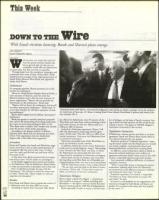
Likud party leader Ariel Sharon, surrounded by bodyguards, smiles during an election campaign visit in the southwest-
ern Israeli town of Yavne Jan. 22. Sharon is leading Israeli Prime Minister Ehud Barak in opinion polls ahead of elec-
tions slated for Feb. 6
has offered the Palestinians some 95 percent of the
West Bank and Gaza Strip, with an exchange of inte-
gral Israeli territory for the rest. Sharon says he is
willing to offer 42 percent.
Instead of a final peace agreement, Sharon "will
offer the Palestinians a long-range interim agree-
merit," Rivlin said. "The bait will be an offer of ter-
ritorial continuum. Until now the Palestinians have
no territorial continuum."
Palestinian-controlled areas of the West Bank cur-
rently are divided by Israeli corridors.
In addition, before the current unrest Palestinians
could travel on Israeli highways along a "safe-passage
route" between the West Bank and Gaza. At times,
the Palestinians have demanded that this route
across Israel be transferred to Palestinian sovereignty.
Sharon spoke recently of creating a train route from
the Gaya Strip to the West Bank city of Ramallah, pro-
viding Palestinians with a new way to travel across Israel.
Will the Palestinians accept a train in place of land?
"We can only move forward on the basis of mutu-
al interests," Rivlin said. "If they don't accept our
offers, we will have to wait for a settlement...
Palestinian Refugees
Sharon refuses to grant the refugees — estimates say
there could be as many as 5 Million, including their
descendants — the right to return to homes they aban-
doned in Israel during the 1948 War of Independence.
Barak reportedly is ready to accept a limited num-
ber of refugees on the basis of family reunions, leav-
ing to Israel the final decision of who would be per-
mitted to return. The figure of 100,000 refugees is
sometimes mentioned in this context.
Population Interaction
If Palestinian violence persists and there is no peace
agreement, Barak and Sharon share similar ideas on
the relations between the two peoples.
Barak has spoken of "unilateral separation," mean-
ing that Israel would treat the Palestinians as it would
any hostile neighbor, erecting 'border fences and
blocking Palestinian workers from entering Israel.
In addition, many Israelis have called on Barak to
dismantle isolated settlements even without an
agreement and move Israeli troops closer to the 1967
borders, unilaterally determining Israel's borders.
Sneh presented a different definition of unilateral
separation, however.
"What it essentially means is keeping the present
settlements, isolating them from the Palestinian
environment by more effective . protection methods,
and hoping for better days," he said.
Economic separation, he insisted, is impossible.
"For better or worse, both parties are stuck with
each other," he said.
In case of a total deadlock in the negotiations, the
solutions envisaged by both Barak and Sharon are
similar: Try to preserve the status quo, but prepare
for the worst. El