

This Week
Crossing A Divide
Jewish groups split on proposed expansion of "charitable choice."
ERIC L. ROZENMAN
Jewish Renaissance Media
Washington
resident George W. Bush has
promised a substantial
expansion of a new approach
to delivering social services
— "charitable choice" — under which
faith-based organizations can bid
against secular agencies for government
money to provide the assistance.
The prospect for expansion, which
will require a variety of regulatory
changes by state and federal agencies,
divides national Jewish groups. Some
oppose it as a crack in the wall of
church-state separation. Others see it
as a long overdue leveling of the play-
ing field between public and private
p
Related editorial: page 35
sectors when it comes to tax-supported
social services. And some await clarifi-
cation from a new White House office
for charitable choice.
Michael Lieberman, counsel at the
Anti Defamation League's
Washington, D.C. office, says the con-
cept means trouble. According to
Lieberman, "the design of 'charitable
choice' is to blow up the firewalls" that
separate religion-centered social servic-
es from taxpayers' money.
Nonsense, says Washington, D.C.,
lawyer Nathan Lewin, who has argued
a number of church-state cases before
the U.S. Supreme Court. "It's an obso-
lete notion in the United States —
that the American Jewish Congress,
American Jewish Committee and ADL
keep saluting — that the minute you
get churches involved in something
with government funding, Judaism's
-
going to hell in a hand-basket."
Charitable choice began in 1996, as
parr of the federal changes that ended
welfare as an entitlement.
How Much, To Whom?
No one is certain yet how much
money will be involved, but estimates
start with at least several hundred mil-
lion dollars. Funds are expected to
flow through individual contracts with
the departments of Health and
Human Services, Education, Justice,
and Housing and Urban
Development.
For example, notes Carl Esbeck,
director of the Center for Law and
Religious Freedom in Annandale, Va.,
"almost all drug rehabilitation is done
in the private sector, but with govern-
ment grants. Charitable choice said
faith-based groups now could have an
equal shot at bidding" for government
money. "But they're not guaranteed
any money; if you can't rehabilitate
people, you're not going to get the
grants.
Former Indianapolis Mayor Stephen
Goldsmith, himself Jewish, may be
tapped to monitor expanded charita-
ble choice programs from the new
White House office. In addition to
drug rehab, projects would focus on
welfare-to-work, after-school and teen
programs, reforming criminal offend-
ers and more.
"Generally, we support it," says
Nathan Diament, head of the
Orthodox Union's Institute of Public
Affairs. "And it's one of the few policy
areas [Democratic presidential nomi-
nee] Al Gore and Bush agreed on dur-
ing the campaign."
Religious institutions such as schools
already may receive government funds
for non-religious purposes, opponents
and proponents of charitable choice
agree. But because of the president's
emphasis on enabling faith-based
organizations to provide social servic-
es, opponents fear tax dollars might be
used to support religious indoctrina-
tion or discrimination in hiring based
on religious beliefs.
Nevertheless, "the constitutional
obligation is fairly simple," acknowl-
edges Marc Stern of the American
Jewish Congress. As decided in an
1898 U.S. Supreme Court case,
Bradfield v. Roberts, "the mere fact of
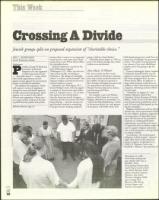
Participants in a Jobs
Partnership training class
pray together after class in
Brenham, Texas.
Participating clockwise from
Andre King at twelve o'clock
are: Maria Espinosa; Yvette
Adams; instructor Suzanne
Flammer; Ana Grant;
Flammer's daughter Hattie
(just visiting); Rick
Rainmer;Ella Dorsey;
Carolyn Hogan; and
Yolanda Cunningham.
1/26
2001
22