

4
itorials
Editorials and Letters to the Editor are posted and archived on JN Online:
www.detroitjewishnews.com
Giving Of Yourself
L
ifesaving accounts resonate through-
out Jewish history. Whether coura-
geous, fortuitous or miraculous, all
are notable. That's because pikuach
nefesh — saving a life — is perhaps the great-
est mitzvah of all.
A heroic act in the heat of trouble is
praiseworthy. It takes a special kind of person
to invite sudden danger.
But to give a part of you, literally, in hopes
of saving a life is a notch up — it's extraordi-
nary.
That's the world of donating body parts.
When illness, deformity or an accident
affects a vital organ, your health is threatened.
But good fortune may result in a very special
gift from a relative, friend or stranger: a
healthy organ.
Within Judaism, there's controversy about
donating body parts after death. Yet there's a
hint of growing interest in, and support for, the
practice among Jews of all levels of observance.
Jews, as a group, are hardly pacesetters in
the practice. But given the proven record of
transplants that have not only saved lives, but
also elevated the quality of life for recipients,
we ask that you consider such a donation.
Whether yOu donate while you are alive or
after you die, your precious gift could mean a
new start for another human being in desper-
ate need.
Study Up
If you have questions about the halachic
aspect of harvesting body parts from either
the living or the dead, consult your rabbi or
another Jewish law expert first. That's certain-
ly appropriate; in fact, it should be part of the
process, given the complexities in defining
death, for instance.
Insightful information is available through
such advocacy sources as Hadassah (the
women's Zionist organization), the Gift of
Life Agency and the Halachic Organ Donor
Association.
Ultimately, resolve to donate when the
opportunity arises. There's a compelling
need and a great reward. A December pack-
age of cover stories in the Jewish News
about organ transplantation poignantly
underscored that.
Our series told about Beth Kahn and Dana
Burnstein, who received kidneys, and 9-year-
old Julia Strecher, who got a new heart — for
the second time. There was even inspiration
in the story of Sheri Devries, who died of a
pre-existing infection after a successful — and
pioneering — double-lung transplant.
All of the stories were heartfelt and hope-
ful. And they erased a lot of myths and mis-
conceptions.
Just as Torah weaves a tapestry of God's
will in our hearts, so does it provide the
threads of reason for sharing a part of our
being with someone gravely ill.
Such sharing — when performed to the
extent possible within the moral, ethical and
technical parameters of our faith — is imbed-
ded in the fibers of chesed, the very Jewish
ideal of lovingkindness.
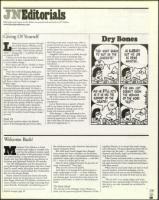
Dry Bones
r
HE ALREADY
QUIT HIS JOB
AS PRIME
MINISTER...
AND HE STILL ACTS
AS F NE HAS THE
SUPPORT OF THE
COUNTRY!
THE MAN JUST
DOESN'T KNOW
THE MEANING
OF THE WORD
QUIT"!
❑
Welcome Back!
111
ichigan's Unity Mission to Israel
returns home today in triumph. Not
only has the solidarity mission raised
the resolve of the participants to help
our Israeli brethren, it has boosted the spirits of
Israelis who have been fighting an insurrection on
the home and diplomatic fronts for 3 1/2 months.
The 200 Michiganders, and the thousands of
young Birthright Israel participants who have visited
Israel in recent weeks, have given Israel's moribund
tourism industry a much-needed shot of adrenaline.
But now the job gets harder.
Recent visitors to Israel have found old myths
shattered. Gone are the pioneers on tractors with
their floppy white hats. The kibbutz movement con-
tinues to fade as suburbs and high-technology busi-
nesses flourish. And Israelis' overwhelming use of
Related coverage: page 26
the cell phone must make American telecommuni-
cations companies drool.
But while many Israeli images have changed,
some remain the same: turbulence on the borders,
hostile neighbors and an unhomogenized Palestinian
population whose right wing threatens — and deliv-
ers — terror if it doesn't get its way.
How do these problems become the purview of
unity "missionaires?" They don't.
They are the concern of all Jews.
And while we encourage Jews and non-Jews to
make a pilgrimage to Israel — to show solidarity
and to boost the economy — such trips cannot be
our ultimate goal. American Jews must strive to be
partners with Israelis, to make our relationship per-
sonal.
.
• The Road Ahead
The real task of the Michigan Unity Mission to
Israel, and the sponsoring Jewish Federation of Met-
ropolitan Detroit, is to convert this week's energy
and enthusiasm. The groundwork has been laid sev-
eral times over the years — for example, Project
Renewal with Ramle, Israel, and Partnership 2000
with Israel's Central Galilee.
What Detroit and Israel needs is a sister-city con-
cept that doesn't end in a few years after fund-rais-
ing opportunities have been completed and plaques
have been erected.
What Detroit and Israel needs are more e-mail
pen pal projects, technical exchanges, tourist
opportunities and one-on-one friendships that
cement our ties to the land of Israel and its peo-
ple.
"We Are One" is an empty slogan until every
Detroit Jew has a personal stake in Israel, a relation-
ship that is not only cherished but revitalized fre-
quently. El
ITN
1/19
2001
39