

This Week
History In The Present Tense
Half a century later, refugee issue casts pall over peace negotiations.
GIL SEDAN
Jewish Telegraphic Agency
Jerusalem
A
fter sitting on the back
burner for 52 years, the
issue of Palestinian refugees
has come to a boil.
Gone are the days when compro-
mise proposals — including repara-
tions or limited family reunification
programs — seemed to offer a way
around the issue.
Since the start of the peace process,
Israeli officials dismissed maximalist
Palestinian statements on the "right of
return" as rhetoric to placate the mass-
es, hinting that negotiators took a
more conciliatory tone in private
meetings.
But as on other issues — Jerusalem,
the Temple Mount, the 1967 borders
— it appears that the extreme state-
ments the Palestinians have made all
along demanding the right of return
accurately reflect their position.
Palestinian officials now say there
will be no peace accord unless Israel
acknowledges that refugees and their
descendants — potentially some 5
million people, according to
Palestinian estimates — are entitled to
return to the homes they abandoned
in Israel during the 1948 War of
Independence.
Even the most dovish Israelis reject
this, saying it basically spells the end
of the Jewish state. Anyone who calls
for the right of return, they say, essen-
tially has not accepted Israel's right to
exist, which supposedly was the under-
pinning for the peace process.
Given the standoff on the issue, an
Israeli-Palestinian peace accord seems
unlikely unless one side changes its
position radically.
1995 Agreement
For years, the demand for the right of
return was obscured by what appeared
to be the Palestinians' main goal —
achieving international acceptance for
an independent Palestinian state. This,
it was believed, would finally fulfill the
1947 UN partition plan's vision of
"two states for two peoples.
Since the Oslo peace process began
in 1993, Palestinian leader Yasser
"
1/19
2001
32
Arafat has spoken of resettling refugees
in the West Bank and Gaza Strip, not
in Haifa,. Jaffa, Beersheba and other
places in integral Israel.
The Oslo formula deferred the
refugee issue and other difficult prob-
lems to final-status negotiations,
believing that the two sides would
have established enough trust by then
to solve them amicably.
In 1995, Yossi Beilin, an architect of
the Oslo accords, reached an under-
standing about the refugees with
Arafat deputy Mahmoud Abbas, better
known as Abu Mazen. In essence, the
two found a way to pay lip service to
the principle of the right of return
without actually implementing it.
Under their informal understanding,
the refugees would be allowed in
unlimited numbers into areas con-
trolled by the Palestinian Authority,
but not into Israel.
For years, Israel has talked of accept-
ing limited numbers of refugees —
perhaps as many as 100,000 — in the
framework of a family reunification
program. In addition, as many as
150,000 Palestinians are believed to
have settled in Israel since the start of
the peace process, illegally overstaying
their work permits or marrying Israeli
Arabs.
Beilin and Abbas also agreed that a
newly created state of Palestine would
be entitled to grant a passport to every
Palestinian, even those living abroad,
remedying the Palestinian refugees'
stateless status.
Abbas quickly disavowed the
"Beilin-Abu Mazen Agreement," how-
ever, and Palestinian officials now say
the understanding has no bearing on
the refugee issue.
Role Of Israeli Arabs
Palestinian officials now say Israel
should at least recognize the
Palestinians' right to return to their
former homes, with the expectation
that many refugees may decide that
returning is impractical.
Given the Palestinians' insistence on
maximalist positions, however, Israelis
increasingly are wary of a wink-and-a-
nod understanding on such an existen-
tial issue.
At issue, Israeli commentators say, is
whether there will indeed be two states
for two people, or whether the
Palestinians will insist on one-and-a-
half states for themselves.
Most Israeli Arabs support the
Palestinian position.
"Of course, we demand that the
refugees be allowed to return," said
Taher Najib, 25, an actor and resident of
the Israeli Arab town of Umm el-Fahm.
"Why should a new immigrant from
Russia become a citizen of Israel, and
my aunt in a refugee camp in Lebanon
is deprived of the same right?" he asked.
After the 1948 war, those
Palestinians who remained in Israel
were thankful that they could stay in
what they call their homeland. Their
children focused on their status in the
Jewish state, demanding equal rights.
But now, the third generation of
Israeli Arabs is demanding the full
implementation of UN General
Assembly Resolution 194, which stat-
ed in 1948 that "refugees wishing to
return to their homes and live at peace
with their neighbours should be per-
mitted to do so at the earliest practica-
ble date."
Moreover, many Israeli Arabs
demand their own right to return to
homes they fled in 1948, often in vil-
lages that no longer exist. Many Israeli
Arabs continue to depict themselves as
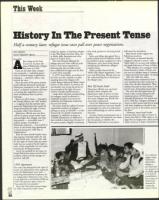
In a Lebanese
refugee camp,
Mahmoud
Saleh Miari
displays a
pre-Israel deed
to a property in
the Safad region
as he asks his
grandchildren
not to drop the
Palestinians'
demand for
reclaiming
land in Israel.