

Question of the Week: Before he became a mobster,
what was the career of Moses "Moe" Annenberg (1878-
1942)?
.
rsa!looci Ot Aipaip 9JDJI GOal WOJ1 UOUDWJOIUI 'saw
GDIAJGS sveu D!LicliaZalai D 6u!loGJD
proD
uiw Li!
ui 'pep! eLp to6 6Jaquauue 4DL A.11311pUl JGdod
fo
-
s grow -
isN6
u! 6upiJom ai!Lim somi! 'ApuusaJalui) -sap:4s panun
-smeu
GHT u! .s.Gdodsmau tSJO8H GLIT 11 0 J°4 Je6ouow uolloinanD so
i
penJes to!5snid 1so ui woci sot OHM 16Jaquauuv uawksuy
\•■■
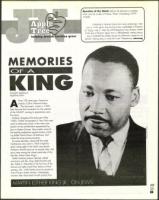
MEMORIES
OF
Elizabeth Applebaum
AppleTree Editor
A
most 100 years ago, Americans
issued a Call to National Action.
The document, written in 1909,
later became the foundation for the creation
of the NAACP; among its signatories were
four Jews.
Similarly, throughout the early part of the
1900s, Yiddish newspapers in New York were
quick to denounce racism; a few even com-
pared it to the anti-Semitism experienced by
Jews in Eastern Europe. Years earlier, some of
the leading spokesmen against slavery, includ-
ing Rabbi David Einhorn of Baltimore, had
made the same pronouncements.
By some estimates, almost half the white
Northerners who went in 1964 to fight for
black voting rights in the South were Jewish.
Perhaps it should come as no surprise, then, that
Jews were among the closest associates of the
late Rev. Martin Luther King Jr.
Rabbi Abraham Joshua Heschel walked
arm-in-arm with Rev. King, Ralph Bunche and
Rev. Ralph D. Abernathy in the front row of the
famous civil rights march from Selma to Mont-
gomery, Ala., while Stanley Levinson served as
one of King's closest advisers. (Interestingly,
Levinson later dissociated himself publicly from
1/12
2001
59