

Enjoy Our Specialties...
SR
• Baby Lamb Shish Kabob
• Lamb Chops Shish Kafta
• Shish Tawook
• Debone d Chicken • Potato Chop
• Chicken Cream Chop
• White Fish
11 S
-.7
I
(American & Chaldean-Style)
_
..' •
LUNCH t
_ IAL
SPEC
-•
..•••A
1,4•4
31
•
of whom is Dan Morgenstern, a
historian and senior adviser on the
Jazz series.
Born in Germany, he and his
family kept one step ahead of the
Nazis before the outbreak of the
war, fleeing from country to
country to escape the Holocaust
and finally settling in Denmark.
Coming to America, he fought in
the Korean War, attended
Brandeis University and became
a journalist, writing jazz columns
for newspapers and magazines.
"When youngsters arrived in
the United States, they usually
wanted to see the Statue of
Liberty, the Empire State
BUilding and other famous land-
marks — I went right to 52nd
Street. It was like making a pil-
grimage to the mecca of jazz,"
Morgenstern recalled.
"Jazz was very popular among
all faiths in Nazi-occupied Europe,
especially the oppressed Jews
because jazz symbolized democra-
cy and freedom for everyone. The
Nazis hated it. I learned to love
jazz after attending a Fats Waller
concert in Europe."
For the past 24 years,
Morgenstern has been the director of
the Institute of Jazz Studies at Rutgers
University in New Jersey, the largest
archival collection of jazz resources in
America. He provided old sheet music,
records and fact-checking services for
the Jazz series.
"When Ken Burns sought advisers for
this series, I was first in line," he said.
"He's an amazing filmmaker and story-
teller, and really catches on fast to some-
thing he doesn't know too much about.
Of course, jazz is a fascinating story of
American life and race relations. "
SANDWICH WITH SOUP
OR SALAD ANY DAY
)
20%OFF
I
Middle-Eastem Dining
29222 Orchard Lake Road,
LUNCH OR DINNER ENTREE
DINE IN OR CARRYOUT
S. of 13 Mile
Farmington Hills
No Sharing
(248) 855-1122
7 DAYS A WEEK!
with coupon
Expires 1-18-01
Call Us For All
Your Catering Needs
Fax (248) 865-6001
www.food.com/desertsands
.
Now Serving Cocktails & Wine
FINE CUISINE IN A RELAXED, CONTEMPORARY SETTING.
Featuring fine traditional and contemporary Italian cuisine as well as
prime Steaks, Chops, Veal, Fish and Seafood. Traditions and quality
continue...Private dining & catering available.
"AN ART IN EATING WELL"
2%/2 miles east of The Somerset Collection on Big Beaver Road
phone
248-680-0066
SINCE 1920
THE TRADITION CONTINUES
Weekend
Dinner
Special
Served Friday,
Saturday and
Sunday
MONDAY-FRIDAY • JAN. 7TH-11TH • AFTER 3:00 P. .
,
2 0% OFF
Jewish Jazz Greats
ENTIRE FOOD BILL
Valid with coupon only
L
• 1 coupon per couple • Not valid with any other discount
• Excludes dinner for two • Dine in only • Expires 1/11/01
Newly Remodeled
FAMILY RESTAURANT
29221 NORTHWESTERN HWY. (Corner of 12 Mile Rd.)
Southfield • t241E33 36E1-2353
Michigan's Hottest Group
Mel Ball and Colours
1/5
2001
Voted #1 Best Band by
Crain ' S Detroit
Business Magazine
(248) 851-1992
-
Two of the central figures in that story
are the Jewish clarinetists Benny
Goodman (born Benjamin David
Goodman) and Artie Shaw (born
Arthur Jacob Arshawsky).
Goodman grew up in a Chicago
ghetto, one of 12 children of an immi-
grant tailor who had fled Russia, and
anti-Semitism. He learned to play the
instrument at a local synagogue and at
Chicago's famed Hull House, then
helped support the family after his
father died, working at dance halls,
then joining drummer Ben Pollack's
band.
His departure from "sweet" music into
a jazz form, during a performance at the
famed Los Angeles Palomar Ballroom in
1935, reportedly marked the beginning
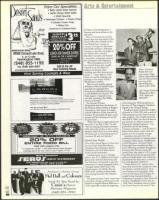
Above: Drummer
Buddy Rich and
cornet player Ziggy
Elman, appearing here
with the Dorsey band,
were two of the
outstanding jazz
soloists of the 1940s.
Left: George Gershwin
"Rhapsody in Blue,"
1924, made jazz
respectable.
of the Swing Era. With his picture on
the cover of Time magazine, Goodman
reigned as the "King of Swing."
Goodman's band reached the heights
of success in 1936-1939 with a series of
CBS broadcasts on the Camel Caravan
radio program. The versatile clarinetist,
who died in 1986, was the first famous
jazz musician to achieve success per-
forming the classical repertory — he
performed with all the leading
American orchestras — and the first to
feature black players when racial inte-
gration was not a popular concept.
Goodman also gave their first
prominent exposure to, among others,
trumpeter Harry James, vibraphonist
Lionel Hampton, drummer Gene
Krupa and tenor saxophonist Stan
Getz. (Winning accolades throughout
his more than 50-year career, the
Jewish Getz, who died in 1991, is per-
haps best known for his pairing with
guitarist Charlie Byrd, with whom he
popularized the bossa nova, a meld of
jazz with Brazilian rhythms.)
A New Haven Ct., native, Artie
Shaw_first learned the saxophone, then
the clarinet, and left home at 15 to
tour America with big bands. After
stints in Cleveland and Chicago, he
joined Irving Aaronson's band in
Hollywood, returned to New York and
became a bandleader on his own in
1936. Soon, foreigners came to know
the United States as the land of "sky-