

Seeking Trust
OU debate on sex abuse report fails to convince some skeptics.
JULIE WIENER
Special to the Jewish News
ith a new president and plans to overhaul
the organization, the Orthodox Union is
trying to restore its credibility after a
report found "profound errors of judg-
ment" in the way OU leaders dealt with a top profes-
sional who is accused of sexually abusing scores of teens.
However, judging from the responses at the organiza-
tion's biennial convention last weekend, it appears that
the new plans will not be enough to satisfy all con-
stituents.
Harvey Blitz, the OU's new president, called the
alleged behavior of longtime youth leader Rabbi
Baruch Lanner a "stain and blemish" on the group —
one "we're going to work hard to remedy."
Rabbi Lanner is accused of sexually assaulting at least
26 teenage girls and physically assaulting many boys
over three decades. A summary of an OU report on the
charges was released Dec. 26.
Blitz, who has been an officer with the OU for more
than 20 years, replaces Dr. Mandell Ganchrow as presi-
dent. Blitz, who had been scheduled to replace
Ganchrow before the allegations came to public light,
said a 13-member commission of board members
appointed by Ganchrow would recommend ways to
implement the report's recommendations.
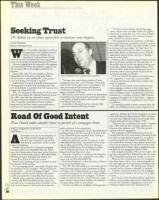
New Orthodox Union President Harvey Blitz.
The report also noted a larger problem of "poor
management practices" in the Orthodox Union. Blitz
said the OU would appoint review committees in the
areas of structure and governance; the National
Conference of Synagogue Youth, the OU's youth
group; personnel; and finance.
Blitz said the Lanner report would be his first priority
as president and promised that the committees would
work quickly, though he did not offer specific comple-
tion dates for their work.
In questions at the session and in comments after-
ward, critics raised the following concerns:
Road Of Good Intent
B'nai David makes another move in pursuit of a synagogue home.
SHELLI LIEBMAN DORFMAN
Staff Writer
A
November move by the membership of
the 108-year-old Congregation B'nai
David is just a temporary step on the
trail toward a permanent home, accord-
ing to its leadership.
Shabbat services for the Traditional synagogue
have been held at the Southfield Marriott Hotel
since the October sale of their most recent facility at
Maple and Orchard Lake roads in West Bloomfield.
The former home of Temple Shir Shalom has
housed B'nai David for the last six years.
B'nai David is seeking to lease a transient location
for the next 18-24 months.
"It is an ongoing search," says Arthur Doppelt, first
vice-president of the synagogue. We are looking for
another place — maybe a synagogue chapel" — to be
temporarily used by the 50 members who attend
weekly services led by Cantor Ben-Zion Lanxner.
Harold Strom, president of B'nai David, says the
recently sold West Bloomfield facility always was
intended to be a temporary place of worship. It was
sold, he said, because it did not fit the long-term
1/5
2001
14
goals and plans of the membership.
In 1990, the congregation sold its Southfield Road
building where it met for more than 35 years to the
City of Southfield, but remained there, renting it
from the city until March 1994.
After that, they held services for one year at the
West Bloomfield Jewish Community Center, keep-
ing an office in Southfield. They then they pur-
chased the 9,000-square-foot building on Maple,
east of Orchard Lake Road, that Temple Shir
Shalom had leased for seven years.
Currently, in addition to meeting at the Marriott
for religious services, the congregation rents office
space near the West Bloomfield site.
B'nai David had been iii three locations in Detroit
prior to the Southfield move.
The 1994 West Bloomfield move was made with the
hope of raising capital to build a permanent building
on Maple, west of Halsted Road. Land was purchased
by several congregants for $213,000 in 1987 specifical-
ly for future construction of a synagogue. The dream
of this new facility ended in a dispute between congre-
gants and three former board members who held gen-
eral partnership of the 10 acres of land.
A lawsuit was filed over an alleged verbal agreement
• The OU will not disclose the full 332-page
report, which names members of the OU's profes-
sional and lay leadership who were aware of Rabbi
Lanner's alleged behavior. The summary released
.
Dec. 26 does not contain names.
• The organization has not stated how it will disci-
pline top professionals, particularly executive vice presi-
dent Rabbi Raphael Butler, who allowed Rabbi Lanner
to continue at his post despite "red flags" about his
behavior. Blitz said he does not think it necessary to
place Rabbi Butler on administrative leave while the
organization decides whether and how to discipline
him and other people.
• Decisions about implementing the report are being
left to an all-male committee of 13 people, four of
whom Blitz said are cited in the report as having some
knowledge of Rabbi Lanner's alleged behavior. Final
decisions will be made by the organization's executive
committee. Fewer than 10 percent of the executive
committee's members are female.
• There is a lack of consensus as to whether the
OU engaged in a "cover-up" to protect Rabbi
Lanner or whether key professionals simply made
errors of judgment.
The bulk of the criticism at the convention came
from synagogue members in New Jersey, many of
Whom allegedly were victimized by Rabbi Lanner or
knew his alleged victims. Outside this core, the OU's
constituency — members in almost 1,000 Orthodox
synagogues throughout the United States — appears
divided as to whether the organization's current plans
are sufficient.
The assembly reached its tensest moment when Elie
Hiller, one of Rabbi Lanner's accusers, stepped up to
regarding a deadline date for the synagogue's purchase
of the land from the three partners. After a two-day,
non-jury trial, Oakland County Circuit Judge Rudy
Nichols dismissed the case in March 1999.
"There was not a meeting of the minds," Doppelt
says. "We could not put a package together and
everyone went separate ways." The three general
partners left the congregation.
The synagogue's 100 members have persevered
through the loss of the court battle, thousands of dol-
lars spent on legal fees and money lost on architec-
tural_drawings for the hoped-for building. They've
also endured the closing of their religious school and
loss of many members who left B'nai David to join
Congregation B'nai Moshe when a proposed merger
between the two synagogues failed in 1994.
Still, Doppelt maintains, "We are very viable." He
says the more than $1.5 million from the sale of the
West Bloomfield building was enough to start over.
"Blueprints for construction of a new synagogue
have been drawn and we have several proposals on
the table right now for a permanent building in the
Farmington Hills area." The land has not yet been
secured, and he declined to identiify its location.
He knows a permanent home for the synagogue
may be far in the distance, but at least it is in sight,
he says.
B'nai David, which describes itself as Traditional,
follows a more modern approach to ritual than that
practiced by Orthodox congregations, while not
wishing to adopt some of the practices of the