

At The Movies
‘
State
Ma
NAOMI PFEFFERMAN
Jewish Journal of Greater Los Angeles
'W
hen David Paymer was a
kid, he used a fake ID to
sneak into New York's
Coronet Theater to see
Dustin Hoffman in The Graduate.
"Hoffman showed me that a short
Jewish guy with a big nose could pros-
per and even be seen as a leading
man," the 45-year-old actor says dur-
ing an interview at the Marmalade
Cafe in Santa Monica, Calif.
Several decades later, Paymer has
prospered as one of the busiest sup-
porting actors in Hollywood, though
seldom as a leading man. He's earned
critical kudos as the scheming Jewish
producer Dan Enright in Quiz Show,
the money laundering Shorty in Get
Shorty, the press secretary Ron Ziegler
in Nixon and a shrink in Lawrence
Kasdan's Mumford.
He's won an Academy Award nomi-
nation for his role as Stan Yankelman,
Billy Crystal's long-suffering doormat-
manager in Mr. Saturday Night. He's
worked with Spielberg, Oliver Stone,
tate and Main, a new film written
a
IRIF and directed by David Mamet,
lillatzah
I 'State and Main,"
a assover staple is the
snack o f choice of the
zoo nTcrow .
76
Robert Redford, and now David
Mamet in the Hollywood satire State
and Main — about what happens
when a movie company sets up pro-
duction in a New England town.
Like 30 percent of Paymer's roles,
the character of producer Marty
Rossen is Jewish, though tougher and
sleazier than the "rabbinical" Enright,
the actor says.
When Marty first arrives on the
beleaguered set, the fictional director,
played by Oscar nominee William H.
Macy (Fargo, Magnolia), greets him in
Yiddish. Rossen promptly threatens
the bimbo-actress (Sarah Jessica
Parker) who refuses to do her nude
scene; he works damage control when
his star (Alec Baldwin) demonstrates a
fancy for under-aged girls; and he
exchanges insults with a blackmailing
local anti-Semite (His favorite slur:
"You speed-trap shaygetz").
The funniest gag is when the fic-
tional filmmakers stock every hotel
room with Streit's matzah: "Can I
have a cracker?" a local asks.
The matzah "is a symbol of the
intersection of Hollywood Jewish cul-
to act since he sat in the front row at
ture and small-town America," Paymer
his community theater in Oceanside,
says, adding that teaching Macy
N.Y., and watched his parents perform .
Yiddish was no easy task.
in benefit shows.
"Mamet and I worked on Bill," he
Like the characters of Stan and
says. "We had to work on Bill a lot."
Buddy in Mr. Saturday Night, Paymer
Studio heads have sent Paymer fan
and his older brother, Steve, per-
letters about Rossen, which surprised
formed for the Jewish relatives in the
some of his friends. "People have
living room; in high school, the the-
asked me, 'Aren't you worried you're
ater department was a place the shy,
biting the hand that feeds you,'" the
un-athletic teen felt he
actor recalls. "But Hollywood
belonged.
loves to skewer itself. Just
Clark Gregg, Alec
But he felt guilty about
look at The Player and Wag
Baldwin, Robert
seeking the limelight. "In
the Dog."
Walsh and David my neighborhood, you were
And it's cathartic for an
Paymer
in David
expected to become a
actor to play a producer, the
Jewish doctor or lawyer,"
guy who runs the show. "You Mamet's "State
and Main."
explains Paymer, whose
feel so out of control as an
mother fled Nazi-occupied
actor," Paymer explains. "I've
Belgium with her family as
never had any producer be as
a girl. "I didn't want to let
nasty to me as Marty, but the
my parents down. I didn't want to be
fear is they're saying terrible things
a 'bum.'"
behind your back. You worry they're
Ironically, it was his father's decision
looking at dailies and yelling 'You
to
leave the scrap-metal business and
stink!' at the screen."
pursue
a musical career that inspired
State
and
Main
Paymer loves
the actor to follow his dream. As pere
because it skewers the vicissitudes and
Paymer went off to earn a doctorate in
inflated egos of show biz, something
musicology, fits David juggled audi-
he knows about firsthand. He's wanted
%,
\MINLIttalank
WE=
12/22
2000
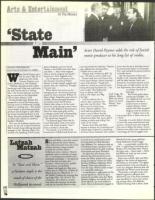
Actor David Paymer adds the role ofJewish
movie producer to his long list of credits.
tells a self-consciously witty tale of the
collision between a heart-of-gold
screenwriter and the shallow
Hollywood movie industry. Mamet's
approach may be somewhat transpar-
ent -- involving unmistakable satire
and broad stereotypes -- but that's all
part of the fun in a story that
becomes a smart and comic parable
about human corruptibility.
Marnet's tale begins as a film crew,
lead by director Walt Price (William H.
Macy), bursts into Waterford, Vt. ---
the "perfect" location for shooting their
big-budget flick, The Old Mill. The
production, set to shoot in another
state where the company has already
built the set, has been forced to skip
town due to an undisclosed scandal
involving lead actor Bob Barrenger
(Alec Baldwin). In a ludicrous send-up
of Hollywood types, members of the
crew quickly disrupt the daily workings
of the quaint and quiet Waterford.
Set apart from this theater of the
absurd is the mild-mannered screen-
writer, Joe White, played with a capti-
vating and delicate wisdom by Philip
Seymour Hoffman (Magnolia, Almost
Famoics). Faced with demands to re-
write the script, White's artistic integri-
ty is repeatedly challenged.
In searching for a replacement for his
manual typewriter, which has gone
missing, he stumbles upon Ann Black
(Rebecca. Pidgeon, the real-life wife of
David Mamet), the town bookstore
owner. She is unfortunately engaged to
Waterford's brash young politician,
Doug MacKenzie (Clark Gregg).
Ann — a surprisingly complex char-
acter — is directing a community pro-
duction of an ironically tided Trials of
the Heart, and — fiance aside — Black
and White are swept up into a sweet
and curious romance.
From start to finish, State and Main
delights in the themes of appearance
and reality, art and artifice. The tightly
constructed plot works marvelously as
it sets up a poignant dilemma that will
ultimately test White's moral fortitude.
The punchy screenplay erupts with
Mamet's signature colloquial style,
delivered by one of the finest ensemble
casts assembled in recent years includ-
ing, among others, Alec Baldwin,
Charles Durning, Patti LuPone, Sarah