

p
erhaps the greatest mitzvah of all, organ donations beget medical miracles every day.
But who are the givers of life, and why don't more Jews surrender body parts to save others?
The following stories are of dearest loved ones and total strangers who had key roles to play in the
desperation and hope of organ transplantation. Next week: The concepts and misconceptions about
Jewish organ donation.
MILY
Sometimes a loved one rides to the rescue.
DAVID SACHS
Copy Editor
B
arely a year into Beth and Jeremy
Kahn's marriage, their plans to raise
a family and have a "normal" life
together were in shambles.
Beth, born 27 years earlier with undersized
kidneys, found herself last May on the brink
of total kidney failure. A kidney transplant
was necessary, but somebody else — dead or
aliye — first had to perform the life-saving
mitzvah of giving one up.
Beth, who lives with her husband in Royal
Oak, was lucky. She had the full support of
her family, including her father, Jerry Cook
of Farmington Hills, who offered one of his
kidneys.
Cook was blood and tissue tested, along with
other family members, and was found to be the
most desirable kidney donor for his daughter.
A successful extraction and transplant was
accomplished in adjoining operating rooms at
William Beaumont Hospital in Royal Oak on
Aug. 30. Each procedure took more than
seven hours.
Cook's surgeons couldn't use laparoscopy, a
modern endoscopic procedure, because of
physiological complications. Instead they had
to perform a traditional, more radical surgery
to get to his kidney.
But Cook not only gave his daughter Beth a
kidney. He gave her a cause.
The whole family, in fact, is doing their
utmost to get more Jews to sign organ donor
cards, a pledge to donate body parts for trans-
plantation after death.
"We're trying to educate as many people as
possible right now," Beth said. "It's hard
because there's so many people who need
organs and there's just a lack of people. If I
didn't get my father or someone else to
donate, I would have had to wait for years on
a list for a cadaver kidney."
The Jewish View
When first confronted with this crisis in her
life, Beth was shocked about how little she
actually knew about the Jewish view of organ
transplantation.
"When I found out I needed a transplant I
went to my rabbi, Daniel Nevins, and talked to
him," Beth said. "I grew up believing that
Jewish law tells you you're not supposed to
donate body parts. He wrote a really nice article
in the (Adat Shalom Synagogue) Voice explain-
ing the Jewish viewpoint on organ donations."
The Jewish mandate for saving the life of
another, pekuach nefesh, is possibly the great-
est mitzvah" of all, said Rabbi E.B. "Bunny"
Friedman of the Jewish Hospice and
Chaplaincy Network in Southfield. Save one
life and save the world is the talmudic call.
Contrary to what many Jews perceive, all
streams of Judaism strongly approve of the con-
cept of donation of bodily organs for transplan-
tation. Orthodox followers of Halachah (Jewish
law) have specific "definition of death" concerns
when the donation is made from a cadaver (to
be discussed in next week's Jewish News.)
According to the New England Journal of
Medicine, Aug. 10, 2000, about 3,000 people die
in the United States each year while waiting for
an organ transplant and about 100,000 potential
transplant candidates die before they are placed
on the waiting list.
"Organ donation is extremely important,"
FAMILY FIRST on page 12
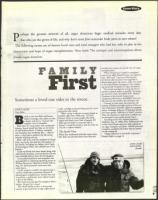
Jerome Zuroff
and his father,
Arnold.
12/2:
2000
7