

SUZANNE CHESSLER
Special to the Jewish News
L
The U-M Museum
of Art hosts an
exhibit of artist
Mark Rothko's
pre-abstract
experiments
with form.
egendary Jewish abstract
expressionist Mark
Rothko's legacy is being
kept alive by his son,
Christopher, who until recently
taught at the University of Michigan.
Now, Christopher's old hometown of
Ann Arbor will host an exhibit of his
father's early work.
"Mark Rothko and the Lure of the
Figure: Paintings 1933-1946" will be
on display through Feb. 25 at the
University of Michigan Museum of
Art. Some of the 15 paintings, select-
ed with the help of Annette Dixon,
the museum's curator of Western art,
are from the National Gallery of Art
in Washington, D.C.
The artist, who eventually devoted
his attention to the abstract, was part
of the Color Field Movement within
the Abstract Expressionist School
and was particularly known for floating segments of
color.
"We tried to select paintings that would give a
representative view of my father's early figurative
work," says Christopher Rothko, who studied for his
doctorate degree and taught at U-M from 1988-
1995 and then practiced clinical psychology.
"The works in that period tend to get lumped
together as an early realist phase, but, in fact, it last-
ed close to 20 years. There were quite a few varia-
tions, changes and modifications that he made to his
style, technique and the messages he was trying to
convey.
"Annette Dixon, with some input from me, came
up with a selection that would express the variety
and show a linear movement from one style to
another. The paintings start with a couple of pretty
early semi-landscapes in which there is a clear figure
and go up to works from the early portion of my
father's surrealist period."
The artist was born Marcus Rothkowitz in 1903
in Dvinsk, Russia, a Jewish settlement. He moved
with his family to Portland, Ore., in 1913 and later
attended Yale University. Biographers say that it was
anti-Semitism at Yale that convinced him to drop
out during his junior year and move to New York
City, where he studied anatomy at the Art Students
League.
12/22
2000
68
Experimentation in giving the human form deeper
meaning led to images that reflected surroundings
and the passage of time. Gradually, the artist began
to distort figures and place them in ambiguous situ-
ations or spaces.
Around 1940, the arrival of surrealist artists exiled
from fascist Europe influenced his style, and he
alluded to legends, dreams and religious rites in
images and titles. He rearranged body parts to form
hybrid beings. Painting people with more obviously
geometrical forms preceded his focus on what would
become purely abstract.
"This body of early work is not terribly well-
known but has a great deal of beauty to it, and I
find the paintings very moving," says Christopher
Rothko, who was 6 when his father committed sui-
cide in 1970. "They tend to be darker and some-
times somber, but there's a real energy in them. I
think they speak to a type of urban alienation.
"A lot of them were painted during the
Depression, and I think they capture the feeling of
struggle that pervaded the country at that time.
That kind of struggle was more intense at that
moment, but these feelings are universal and can
,,
speak to us today.
Rothko finds that two paintings in the Ann Arbor
exhibit speak in special terms to him. A picture of a
boy standing by a window is a rare example of his
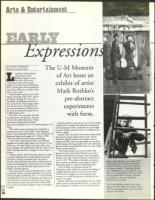
Above; Mark Rothko in his studio, 1952.
'Most pewple who talk about my fiztlyer's
artwork talk about a very strong spiritual
or religious element," Christopher Rothko
says. ",although it would be difficult to say
that it was a specifically Jewish one I know
that my father always thought of himself
very clearly as a Jew, n©t religiously
but certainly ethnically."
,
Top; Mark Rothko's untitled oil on linen,
known as "Four Figures in a Plaza," circa
1932 is among the artist's early work to be
shown in Ann Arbor.