

azel
Tole.
. .
At left from top: Brin family
dreidely — blownglass, Israeli
scene, metal, silver plated.
Chaim Roetter's sterling silver
and brass dreidel.
Villn Hebrew, it's called a
sivivon (si-vi-vone), but in
America, the spinning
Chanukah tops are mostly
known by the Yiddish name "dreidel."
Perhaps the only toy unique to the
Jewish religion, the four-sided tops serve to
remind us of the miracle of the Chanukah
story while we play. Hebrew letters are
inscribed on each face of the dreidel. In
Israel, the letters are 3 Nun, a Gimmeh n
Hey and n Pey, initials for the Hebrew
"A great
phrase Nes Gadol Hayah Poh
miracle happened here."
Outside of Israel, the last letter is a xi
"there," refer-
Shin, for the word Sham
ring, of course, to Israel.
Legend has it that, back about a couple
of thousand years, at the time of the
Chanukah story, something like a dreidel
helped save the Jews.
Under persecution from their enemies,
the Jews were forbidden to learn Torah on
pain of death. Still, they risked their lives
and met secretly to study together. If found
by the soldiers, they took out something
like a dreidel and pretended to be gambling
instead (of course, the dreidel couldn't have
had the letters we use today, since the mira-
cle hadn't happened yet!).
Nowadays, even though gambling is
normally frowned upon by the Jewish reli-
gion, games of dreidel are played as a fun
family pastime while the menorah candles
are burning and the latkes are frying.
—
—
. • A a
• a - to
NOW,'
.
WI
•
p
m:
mtvk
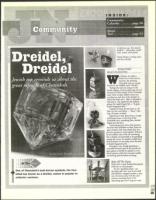
One of Chanukah's best-known symbols, the four-
sided top known as a dreidel, comes in popular to
Rules Of The Game
Here's how to play dreidel (best played •
with four or more people):
For the "gambling chips," use
chocolate Belt coins, nuts in the shell
(like filberts), wrapped candies or pen-
nies. Everyone starts with the same
amount, anywhere from 5-10,
depending upon . how long you want