

Losi Thn sFArab Vote
Israeli Arabs supported Barak
in '99, but not now.
LARRY DERFNER
Israel Correspondent
Jerusalem
ne of the ABC's of mod-
ern Israeli politics is that
Labor's candidate for
prime minister must have a
massive bloc vote from Arab
citizens in order to win. And
one of the ABC's of Prime
Minister Ehud Barak's electoral
misfortunes is that since the
October riots in which police
killed 13 Israeli Arabs, he has
lost this linchpin to his hopes
for re-election.
So Barak, or his advisers,
came up with what they
thought was a safe, sure way to
start off his campaign to win
back the Israel Arab vote.
He'd eaten hummus in the
Israeli Arab town of Tira plenty
of times — it's a quick ride
from his home in Kochav Yair,
O
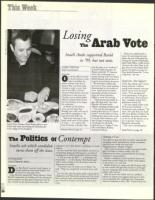
Israeli Prime Minister Ehud Barak's efforts to woo
Israeli Arab voters by breaking the Ramadan fast
in the village of Tira backfired.
The
Politics
Related editorial: page 35
Of
Israelis ask which candidate
turns them off the least.
AVI MACHLIS
Jewish Telegraphic Agency
Jerusalem
ror Ben-Roohi watched with disgust as
Israel's political arena sank deeper into
turmoil over the past week.
Snap elections sparked by Prime Minister Ehud
Barak's resignation on Sunday, and the subsequent
announcement by Binyamin Netanyahu that he,
too, would run for the premiership, have done
D
12/15
2000
26
and the place is as "moderate"
as Israeli Arab towns get. So
Barak, trailed by TV cameras,
went into a restaurant one
recent evening with Tira Mayor
Khalil Kassem and sat down to
a good, reconciliation hummus.
But this time it didn't play,
not even in Tira. Local residents
demonstrated in the middle of
town. Israeli Arab journalists
reportedly refused invitations
from the Prime Minister's
Office to cover the meeting.
"The hummus was spoiled. It
gave off a bad smell," says Arab
Member of Knesset Issam
Mahoul, speaking metaphorically
This was the stereotypical
Israeli politician's act of "patron-
ization" toward Arabs, he notes,
thinking that all you have to do
is eat the Arabs' hummus and
they'll forget everything, forgive
everything. But all Barak
achieved was to "disgrace" him-
self, as did Mayor Kassem,
maintains Mahoul.
Contempt
nothing to revive Ben-Roohi's confidence in Israeli
politics.
He has voted for both men before, and now is
considering doing something once considered
sacrilegious in Israel's politically driven society.
"I will not vote for Bibi" — a nickname for
Netanyahu — "or for Barak," Ben-Roohi said
with a sneer, sitting in his electronics store in
downtown Jerusalem.
"I have no trust in either one of them," he
said. "They are completely detached from reali-
ty ',
Just one day after Barak formally submitted his
resignation and Netanyahu announced his return
from political exile, sentiments like Ben-Roohi's
were voiced by Israelis across the political spec-
trum.
Barak even added insult to
injury by convening the meal
before the end of the daily fast
during this month of Ramadan,
adds Nadia Hilou, a Jaffa activist
who quit the Labor Parry in dis-
gust last year when Barak didn't
protect her hard-won place on
One Israel's Knesset list. "It was
a big show," she says.
Suspicion, Not Support
These days, Barak can't win for
losing with the 1 million-
strong Arab minority, who rep-
resent one in every six Israeli
voters. "If we eat hummus,
we're patronizing. If we go to
an Arab bazaar, we're patroniz-
ing," complains Labor Party
spokesman Yerach Tal.
Last year, Israeli Arabs voted
95.8 percent for Barak — "a
Communist-style majority," Tal
notes. Not only that, but Arab
MK Azmi Bishara withdrew his
candidacy for prime minister
on the eve of the election so as
not to give the victory to
Binyamin Netanyahu.
This time, everything has
ARAB VOTE on page 28
Hitting A Low
On a gloomy gray day that accurately captured the
prevailing mood, Jerusalemites chosen at random
used the same words over and over:
Disappointment. Despair. Disgust.
The confusion that has settled over many Israelis
after 10 weeks of violent conflict with the
Palestinians has been compounded by increasing
mayhem in Israeli politics.
Israelis' confidence in their political system has
never been terribly high, but recent events appear
to have sent it to a new low
Barak's decision to resign and call elections with-
in two months will spare the country a prolonged
election campaign that neither politicians nor the
public really wanted.
Still, his move was widely seen as a political
scheme to improve his sagging chances of re-elec-
tion by heading off a challenge from Netanyahu,
whom he defeated in May 1999. Under Israeli law,
,