
Greek and American Cuisine
OPEN 7 DAYS A WEEK
154 S. Woodward, Birmingham
(248) 540-8780
Halsted Village
(37580 W. 12 Mile Rd.)
Farmington Hills
(248) 553-2360
Story In Gouache
Living during the Holocaust, a young artist re-created
both the happiness and the horror.
the times of her life
6527 Telegraph Rd.
Corner of Maple (15 Mile)
Bloomfield Township
(248) 646-8568
4763 Haggerty Rd. at Pontiac Trail
West Wind Village Shopping Center
West Bloomfield
(248) 669-2295
841 East Big Beaver, Troy
(248) 680-0094
SOUTHFIELD SOUVLAKI
CONEY ISLAND
Nine Mile & Greenfield
15647 West Nine Mile, Southfield
(248) 569-5229
FARMINGTON SOUVLAKI
CONEY ISLAND
Between 13 & 14 on
Orchard Lake Road
30985 Orchard Lake Rd.
Farmington Hills
(248) 626-9732
NEW LOCATION:
525 N. Main
Milford
(248) 684-1772
UPTOWN PARTHENON
4301 Orchard Lake Rd.
West Bloomfield
(248) 538.6000
HERCULES FAMILY RESTAURANT
33292 West 12 Mile
Farmington Hills
(248) 489-9777
Serving whitefish, Iamb shank,
pastitsio and moussaka
Receive
no/
Uwit) Off
Entire Bill
I not to go with any other offer I
I
I
with coupon
12/15
2000
90
Expires 12/3W2000
ME. MI MI =I MN
MEI MI MI
SUZANNE CHESSLER
Special to the Jewish News
M
ultiple images of a young
woman at a sketch pad fill one
painting. A solid block of
marching Nazi soldiers occu-
pies another. A performing orchestra domi-
nates a third.
All are by a German-Jewish artist killed in
Auschwitz in 1943 and remembered through
the touring exhibit "Charlotte Salomon:
Life? or Theatre?" now on display at The
Jewish Museum in New York.
Organized by the Royal Academy of Arts
in London, the exhibit of 400 works, accom-
panied by text and musical references, re-cre-
ates the frightening atmosphere in which
Salomon lived. Besides confronting the Nazi
threat, she was coming to terms with the
knowledge that many people in her family
had committed suicide.
The paintings, however, are not restricted
to sadness. They also capture moments of
intense happiness, love and wonder.
"I will create a story so as not to lose my
mind," Salomon wrote of her 800 gouaches
produced between 1940 and 1942 and
entrusted to a friend before she was taken to
the concentration camp and killed at age 26.
Painted with only primary colors and
white, the images are a fictionalized autobiog-
raphy incorporating important and influential
individuals in her life. The works are struc-
tured as scenarios set to specific pieces of clas-
sical, folk and popular music and are annotat-
ed and intricately woven with narrative.
"This exhibit provides an extraordinary
opportunity to see work historically rooted
and contemporary in style," says Mason
Klein, assistant curator of fine arts at The
Jewish Museum. "The artistic melding of
personal and political images makes the
works relevant and has captured the atten-
tion of the art world."
On loan from the permanent collection of
the Jewish Historical Museum in
Amsterdam, the renderings have been shown
at the Museum of Fine Arts in Boston and
the Art Gallery of Ontario in Toronto. Audio
tapes are available so viewers can experience
the full impact of the artist's intentions.
Salomon, born in Berlin in 1917 to a mid-
dle-class Jewish family, studied at the city's
State Art Academy from 1936-38. After the
Nazis forced her to leave school because she
was Jewish, Salomon was sent to live in the
south of France with her grandparents.
Supposed to reunite shortly with her father
and stepmother, contralto Paula Lindberg,
she was stopped by the circumstances of the
hostilities and interned with her grandfather
in the French concentration camp of Gurs.
Released in 1940, Salomon returned to Nice,
began working on "Life? Or Theatre?" and
married Alexander Nagler, another Jewish
refugee. The Nazis found the couple and sent
them to Auschwitz when she was four
months pregnant.
"Salomon clearly was influenced by a number
of artists from German expressionists to
Modigliani," Klein says. "She also was influenced
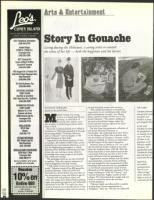
LO- to right:
Charlotte Salomon's
portrait of her moth
and father and
herself as a young
girl alongside them.
In this work,
Charlotte has joined
her grandparents wl
are waiting out the
war in the south
of France in the
auesthouse on the
6
villa of a wealthy
American. Her
grandmother scolds
Charlotte for being
lazy and only con-
cerned with her art
Inspired by
her mentor's
pronouncement
that she is an
"above average"
artist, Charlotte
begins a series of
watercolors for hin
Scanned image of the page. Keyboard directions: use + to zoom in, - to zoom out, arrow keys to pan inside the viewer.
December 15, 2000 - Image 128
- Resource type:
- Text
- Publication:
- The Detroit Jewish News, 2000-12-15
Disclaimer: Computer generated plain text may have errors. Read more about this.