

FOREVER OURS
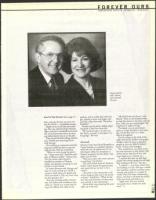
AMBASSADOR DAVID B. HERMELJN, 1936-2000
David and his
wife, Doreen,
were married
42 years.
LIFE
To THE FULLEST from page 15
door, and says he's got an arrest war-
rant for David — a gambling charge.
People not in on the joke are scream-
ing. The man reads David his Miranda
rights, puts him in handcuffs in the back
of a car and drives him down the drive-
way before they let him in on the joke.
That started the ball rolling, Doreen
says. Friends start haunting David
with this guy.
He would go to restaurants and this
same guy would be there to put the
cuffs on him. He'd be everywhere.
"When we were young, he said to
me, `I hope some day I could be presi-
dent of Shaarey Zedek,"' Doreen says.
The day comes when David is
installed as president of Shaarey
Zedek, the speeches are going on and
David is on the bimah.
In comes Borman with this guy and
they sit in the second row. David is
trying to think about his speech and
all he can think is "Oh, my God, what
are they going to do?"
He's just sweating bullets, Doreen
says. Just before the installation they
walk out. David is so scared and try-
ing to be official. He walks to the
podium, and in walks Paul with this
guy, playing a drum and bugle, and
carrying a sign that reads "David for •
President."
Doreen says he always talked of get-
ting back at Paul but never did.
"He wanted to get a car that was
like Paul's, compact it and place it in
his garage," she says.
Farewell
Doreen Curtis met David Hermelin at
Camp Tamakwa in northern Ontario
when she was 10 and he was 12. As
David grew older, his attraction to
Doreen increased, but her father, Ted,
didn't care for him.
"He's just a joker who won't amount
to anything," he told her.
The joker fooled them all. Raised a
family, raised money for good causes,
and raised the bar on how to be a
mentsh.
"You look in the community at all
of the things he did, and it all started
at home," said Karen. "What he did
here first and foremost, he then went
out and did in the community."
David didn't stop enjoying life until
right up to the end.
"My Dad loved one-liners," said
Marcie: "Even in the hospital when
we laid him down in the bed, we'd ask
him, 'Dad, are you comfortable?' He
would say, 'I make a living.'"
The family is at an anniversary
party at Camp Tamakwa a few years
ago. It's the first time in a while
they're all together.
David's sitting at the head of the
table•with all his children and grand-
children when he spots a group of
people at the next table he doesn't
know. They're total strangers.
"For a solid hour, my father turns
his total attention to this family, tells
all his stories, does his shack, and
never looks at us," Marcie sav-.
"I realized that after my dad died,
people were always saying he's still right
here, looking at all of us," she says.
"I realized — you know what? He's
not looking at us vet. He's got a whole
new audience, and he's up there enter-
taining, and maybe in a couple of
weeks, when he's done entertaining
them, and they've all heard his shtick,
he'll come back and look at us.
"Right now, he's very excited
because he has a whole new audi-
ence." ❑
12/1 1
2000
17
,