
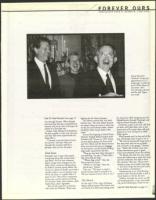

AMBASSADOR DAVID B. HERMELIN, 1936 2000
-
David Hermelin
"somberly" accepts his
appointment as U.S.
ambassador to Norway
at the White House in
December 1997.
Vice President At Gore
and his wife Tipper
are at left.
LIFE
To THE FULLEST from page 12
trip through Europe. When friends
convince him that she would kill him
because she's never been to Europe, he
settles on a four-day trip.
France. Italy. Skiing in Switzerland.
We had a guide in every city, she says,
and they had never experienced any-
thing like it.
"I wanted to see the Mona Lisa in
the Louvre," she says. They ran
through the museum halls for a
glimpse, then ran for the plane.
Food Issues
Hermelin was "a man who tasted
everything about life, except food,"
says Brian. As if on cue, someone
places a large bowl of grapes on the
table. Brian continues talking about
his father's peculiar eating habits: He
never ate a piece of cheese, never had a
noodle unless it was in chicken soup.
Never ate pizza, or a gefilte fish or a
grain of rice. Never had a condiment
except salt. and he salted everything.
He ate plain steak, plain chicken, plain
lamb chops, plain vegetables.
"He was the only Jew in America
who never ate Chinese," Brian says,
fighting for his share of grapes.
The salamis started way, way back,
Doreen says. "He took salami because
no matter where we went or what was
served, he could always make a salami
sandwich when we got back to the
room."
Picture David going to Israeli Prime
Minister Yitzhak Rabin's funeral with
President Bill Clinton in 1995. There
are two planes going, Air Force One
and Two. Brian says the Secret Service
lines up everyone's carry-on baggage
on the tarmac, and the bomb-sniffing
dogs make a pass down the line.
"They go into heat when they get to
my dad's bag," he says. "They're liter-
ally mounting the bag."
"'Whose bag is this?"' they ask.
David raises his hand.
"'What's in the bag?"' they ask.
David says, "Salami."
They say, "'We knew it wasn't a
bomb, because they're trained to sit.
We just wanted to know what it was.'"
The Shreck
It's the early 1970s, when Michigan
begins selling Instant Win lottery tick-
ets. David is in full fund-raising mode
for American ORT (Organization for
Rehabilitation through Training), and
calls his friend Norman Folby.
David has a plan: Let's buy 100 tick-
ets each, we'll take them over to my
house and we'll scratch them off, and
whatever we win we'll give to ORT.
Folby agrees.
Word spreads and, by the end of the
day, 100 people want to get in on it.
"We end up having this huge event a
few days later, and we set up tables
and a brunch in the garage," Doreen
says. "Tables full of food, stars-and-
stripes decorations, guys in green
visors and armbands count the tickets.
"To David, the only way you could
count the tickets was to wear the visors
and the armbands. You had to have
the costume," she says. "If you were
singing a song, you couldn't just sing
— you have to get the hats and canes.
It was always a production."
Unbeknownst to us, Paul Borman
and few other friends decide to pull a
shreck (joke) on David, she says.
Halfway through the event, an offi-
cial-looking person, a big, scary-look-
ing, pock-marked guy, comes to the
LIFE To THE FULLEST on page 17