
EDDIE FISHER:
"He had one of the
biggest egos in the business.
Almost immediately after
Jolson died, Eddie decided
to dedicate his career to
Jolson. They got permission
from Al Jolson's widow to
come out to the house.
"Now, this is a widow, and
Eddie had no respect. He
came to the house and
looked around and saw this
marvelous oil painting of
Jolson in black face, and he
said, Lets get this picture
and I'll stand next to it.' He
wanted to move the couch,
and I said we shouldn't. But
he started moving the furni-
ture and Jolson's wife walked
in and yelled, 'Everyone out!'
"I was so embarrassed.
Fisher didri't care — he was
sitting on top of the world
at that time.
AL JOLSON:
"Meeting Jolson was truly
one of my greatest experi-
ences. I was 22 years old and
assigned to photograph him
for Time magazine. Jolson
lived on top of the mountain
above Beverly Hills and
when I rang the bell, he
answered the door dressed in
beige shorts and a shirt.
"Once in the house it was
overwhelming. I said I
would like a picture at the
piano. I got everything all set
and he said, `Do you want
me to sing something?'
"I said, 'Toot, Toot,
Tootsie,(Good-Bye).' He
started to sing and I was so
mesmerized, nothing hap-
pened — I didn't take a pic-
ture. At the end of the song
he said, W
'hat's wrong,' and I
said, 'Mr. Jolson, the second I
heard your voice, I froze.'
"My eyes welled up with
tears and from the piano
stool Jolson came over to
me, gave me a big hug, and
said, 'Lees try it again, kid.'"
TONY CURTIS:
"When he first came to
Hollywood, and was an
unknown named Bernie
Schwartz, he was one of the
most beautiful people. I was
out every night covering
Hollywood and he walked
up to me and asked if I
would take his picture with
the big stars. He said he
would just walk up to them
and stand next to them, and
asked me if I could snap a
picture. So I did.
"Whether it was Clark
Gable or Cary Grant, he
didn't care. He just walked
up to them like they were
old friends and I would take
the picture.
"I worked at the New York
Daily News and the editor
called up my agent and
asked, 'What is going on
with Garrett? Is he related to
this Schwartz guy? Schwartz
is in every layout with all
these movie stars.'
"I said, 'I think this guy
will be a big star one clay' I
was right."
"
DINAH SHORE:
"She was a professional
and perfectionist who knew
exactly what she wanted. She
was not an easy taskmaster,
but she was a tremendous
performer and everyone had
the greatest respect for her." .
*A*4
WALTER MAYI'HAU:
He was one of the real
gems who came from
Broadway to film and Was
loved by everybody,. He was
a consummate professional.
If asked to do silly PR stuff,
he would do it. He under-
stood it was part of the
business. He was a real joy '
EDDIE CANTOR:
"Every week my family
would sit around the radio and
listen to [Eddie Cantor], and
suddenly I found myself at his
home. What a thrill. Eddie sat
around and talked about what
it was like being in show busi-
ness at the turn of the century
"He told stories about
George Gershwin and Jimmy
Durante, and it was the first
time in my life I would have
gladly given up my camera
for a tape recorder. It was the
most incredible 20 minutes I
ever had."
MILTON BERLE:
Since the 1940s,
Murray Garrett
has photographed
countless familiar
MARILYN MONROE:
"I never saw her as a
brassy blonde — I always
saw her as a vulnerable,
frightened young lady who
was continually hounded by
the press. Photographers
would chase her, and while
she liked the publicity; she
was terrified of big crowds.
"I started photographing
her long before she changed
her name to Marilyn Monroe.
She worked for $25 for
cheesecake layouts — two-
piece bathing suits, which
were daring in those days."
"I met him during the war.
I was asked to take a picture
of Berle and a soldier, a
Chinese major who had been
shot and sent to this country
for rehabilitation. Milton was
very famous and it was sup-
posed to be an honor for the
soldier to be photographed
with Milton. But the flash-
bulbs didn't work very well.
"I got into the dressing
room and the first bulb didn't
go off , then the second bulb
didn't. Finally it did, but Berle
picked me up by the sear of
my pants and the nape of
my neck and said, 'I don't
have any time for this,' and
tossed me out of the room."
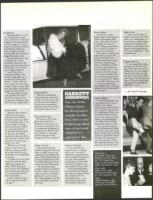
Top ofpage:
A beaming Dinah Shore
departing with her Emmy
fir "The Dinah Shore
Show," at the Moulin Rouge
Night Club Theate;; 1956.
Above right:
Eddie Cantor, right,
showing some dance steps
to a very young Joel Grey.
Right:
Audrey Hepburn, right,
socializing with Debbie
Reynolds and Phil Silvers.
JERRY LEWIS:
"I didn't find his sense of
humor very funny. He would
walk up to a butter plate at a
formal dinner, stick his finger
in the butter and then rub
the butter on the camera lens.
People would laugh because
they were embarrassed — but
it wasn't f u nny."
LAUREN BACALL:
It was impossible to take a
"
bad picture °filer. She was a
top model before she came to
Hollywood. She was already a
famous New York cover girl
She had a fairy-tale love affair
with Bogart. She had amazing
beauty and didn't mind being
photographed, although she
didn't like to pose."
— Alice Burdick Schweiger
Scanned image of the page. Keyboard directions: use + to zoom in, - to zoom out, arrow keys to pan inside the viewer.
December 01, 2000 - Image 135
- Resource type:
- Text
- Publication:
- The Detroit Jewish News, 2000-12-01
Disclaimer: Computer generated plain text may have errors. Read more about this.