

This Week
Elusive Peace
Sleepless In Gilo
Under Palestinian fire, residents weigh their options.
o
g "••• ,
•
' f4
,
*Anyit4Itkt ,
ri •
4*. -•
**
'
Ott
When the shooting starts, the Burchatts sit in
their living room, with its heavy Danish antique
furniture, making sure to put stone and concrete
between them and any incoming ordnance. They
sleep in an improvised back bedroom, which nor-
mally serves as his studio.
Burchatt has a grown-up daughter living on the
other, safer side of Jerusalem. She has offered a
refuge, but her father is adamant.
"If I leave this house," he says, "I'll leave the coun-
try. I'm an artist. Look at the view. For me, that is
everything. I work here. Now I can't paint, I can't
write. I can only listen to the radio, but that's no
life."
He brings out the manuscript of a book he has
written and illustrated called "Homage to the
Palestinians." He knows people from Beit Jalla.
"I'm glad I haven't published the book yet," he
reflects, "but I will do if there is peace."
He doesn't blame the Arabs. "We're human
beings," he says, "so are they. Why don't we have
leaders who can solve the problem?"
Few Choices
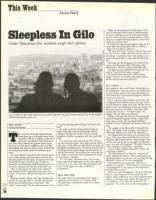
Jews overlook the West Bank Palestinian town of Beit Jalla from the Jewish neighborhood of Gilo, on the southern
outskirts of Jerusalem on Oct. 24.
ERIC SILVER
Israel Correspondent
Jerusalem
T
he view from Nerio Burchatt's balcony,
three floors up on Ha'anafa Street, is eeri-
ly familiar. We see it nightly on the televi-
sion news: the pillared, red-roofed man-
sion from which Palestinian gunmen shoot across
the ravine at their Jewish neighbors, the same Beit
Jalla hillside that takes the brunt of the rockets fired
in retaliation by Israeli tanks and helicopter gun-
ships.
As we sit behind a cascade of multi-colored gerani-
ums in their plump terra cotta pots, he pours me a
beer and passes his binoculars, de rigueur these days
for families living on the front line in Gilo, a
Jerusalem suburb housing 42,000 people, built on a
mountain captured from Jordan in the 1967 war.
"You see that gap to the right of the mansion?"
asks the 68-year-old Argentinean-born artist and
writer. "There was a second building there until last
night."
Burchatt and his Danish wife, Inga, bought a flat
in Gilo 22 years ago. She is a 53-year-old architect.
They were among the first to move here. "We
came," he says wryly, "for the peace and quiet. I can
11/24
2000
28
sit up here painting and writing to my heart's con-
tent."
Or could, until the second Intifada broke out
eight weeks ago, until six machine-gun bullets
slammed through the window of his next-door
neighbors, Russian immigrants with two small chil-
dren.
It is noon on a sunny, late-autumn day. You can
see what Burchatt means. All is still, pastoral. Half a
mile away, in Beit Jalla, an Arab Christian outpost of
Bethlehem, nothing moves. The honey-colored stone
buildings clamber up the slope, the olive groves are
ripe for harvesting. Church bells echo across the val-
ley. Traffic on the Israeli settler bypass, down below,
is too distant to disturb.
"I'm not afraid," Burchatt insists, "but I worry
about Inga. She's frightened, but she won't admit it.
I can see it in her eyes. If the shooting doesn't end
soon, I shall suggest she takes a holiday in
Scandinavia."
Book Must Wait
The night before, the exchanges of fire began at
dusk and continued till 2 a.m. Further along
Ha'anafa Street, a Palestinian rocket set an apart-
ment on fire.
His neighbors, Boris and Hanna Shtrikman, are
less philosophic. You can still see the bullet holes
in their floral curtains. One shot skimmed over
the head of their 5-month-old daughter, Michal,
as she lay in her cot.
Boris, a 46-year-old computer technician who
immigrated from Moscow nine years ago, shows
me the flattened copper shell case. He has built a
wall of stone and sandbags outside the window to
keep out any more. He had to take three days'
unpaid leave to do it. "I've lost money," he
shrugs, "but do I have any choice?"
Hanna, a 38-year-old nurse in the emergency
ward of Hadassah hospital, works a night shift
three times a week. She was breast-feeding
Michal, but her milk dried up because of the ten-
sion.
The couple worry about their 5-year-old son,
Alon. "He doesn't want to sleep," says Hanna.
"He keeps telling us to watch the television."
The family have all moved into one back bed-
room. They have none of the bluster or zeal of
messianic West Bank settlers. They bought a flat
in Gilo because the price was right, the develop-
ment airy and well designed. "We didn't think we
were coming to a settlement," says Boris.
Some of their neighbors have left. Others are
preparing to follow.
"It's impossible to live like this," says one of
them, Emmanuel Cohen. "We are looking for an
apartment where we can live, not just keep hitting
the deck. I feel as if I'm on a battlefield."
Boris and Hanna are staying. "We have no
option," he explains. "We live here, we have a boy
in kindergarten. In any case, no one would buy
this flat from us now."
Others are not so phlegmatic. Back on Ha'anafa
Street, a maintenance man was mending tele-
phone cables nibbled by mice. He'd repaired them
before, and for the same reason, but this time it
was different. "The mice are scared stiff," he
reported. "I've never seen so many droppings."
❑