

On The Bookshelf
A Life In Waiting
In a new memoir, author Debra Ginsberg shares delicious stories
about a profession that employs 2 million Americans.
ALICE BURDICK SCHWEIGER
Special to the Jewish News
fter 20 years of waiting tables at the dingi-
est of diners to the fanciest of restaurants,
Debra Ginsberg has "seen it all." And in
her new book, Waiting: The True
Confessions of a Waitress (HarperCollins; $22), she
shares her experiences as a server and offers her
insights on the behind-the-scenes restaurant life.
Ginsberg demonstrates that waiters and waitresses
are "often intelligent, creative human beings, with
eyes and ears and feelings."
Yet, she writes, "many guests
(I can't say all) also assume
their waiter or waitress is a
complete idiot. Who else but
an uneducated fool would
take a job waiting on them?"
A single mother who has
waited tables to support her
other career as a freelance
writer and editor, Ginsberg
says she "wanted people to
know that servers are not nec-
essarily blue collar."
"Some of the most talented,
imaginative and intelligent peo-
ple I've met are my fellow wait-
ers and waitresses," she writes.
"All of those people were also
very good at their job.
"I've also seen examples of
the reverse, waiters and wait-
resses from hell, who, unsur- ..,,Aii
prisingly, didn't last a long
time in the game and who went on to jobs that
supposedly require many more skills."
In her book, Ginsberg tells of patrons and their
horrendous, sometimes bizarre, eating-out behav-
ior. At one restaurant, a particularly challenging
couple, who appeared to be on a date, insisted on
creating their own dish.
The man, whom Ginsberg privately nicknamed
"Gold Chains" because of his gaudy jewelry, was set on
ordering his version of shrimp scampi with pasta. He
didn't care that it wasn't on the menu.
In trying to placate the harassing duo, Ginsberg, as a
last resort, brought the chef over to their table. Pulling
the chef out of the kitchen seemed to work in her favor.
The chef and the man eventually worked out a seafood
dish to his liking, and, after a long grueling evening, the
man rewarded Ginsberg with a generous tip.
However, she points out, not all of her experiences
have had happy endings, and tipping does not always
reflect the service. "I strongly believe that there are
[customers] who simply feel compelled to complain
when they dine out," she writes. "For these people,
11 / 17
2000
94
venting frustration at a waiter, waitress or manager is
(possibly) their only form of therapy."
In her book, Ginsberg devotes a whole chapter to
tipping.
"Tips are not just a side perk," she writes. "They are
not an added bonus. For a waiter or waitress ; tipping
is the raison detre of [working at] a restaurant, consid-
ered an absolute right by those on the receiving end."
The biggest tip Ginsberg ever received was $100 —
for opening a bottle of champagne. "It was totally
unexpected but greatly appreciated," she says, adding
that tips for servers nowadays should be 20 percent.
As for tip-challenged customers
who frequent the same spot, they
"get not only the worst service,"
writes Ginsberg, but "leftover
bread, dirty glasses and plates that
have been prodded at and some-
times eaten off. When a regular is
high maintenance and a bad tipper,
servers really lose it," she adds.
Ginsberg's exposure to the restau-
rant business began when she was a
child. Both her parents worked in
hotel eateries in New York's Catskill
Mountains. Her first serving expe-
rience, in 1978, at age 16, was at
a luncheonette located in the
middle of Maxman's Cottages,
a predominately Jewish bunga-
low colony in the Catskills.
"It was both fun and hard
work, and was a summer that
I will never forget," says
Ginsberg, who grew up in
New York and Oregon. "It
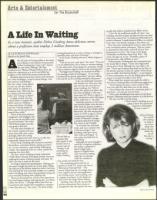
The real dish on
was a great introduction to
restaurant life:
waitressing."
Most people in this
Although she never thought it
business are in a
would be a longtime profession,
constant state of
the author, a graduate of
"waiting" to do
Reed College with a
something else,
degree in English litera-
writes author
ture, wound up waiting
Debra Ginsberg.
tables for two decades
while she worked on
her novels and raised her son.
Her waitressing stints took her to
eateries on both U.S. coasts, and one in
Yellowstone National Park. "The
money helped pay for my college educa-
tion, support my son and supplement
my writing career," says Ginsberg, now
a regular contributor to the books sec-
tion of the San Diego Union-Tribune.
Ginsberg, who is Jewish, says she did
not face antisemitism from patrons or
management. But, she reports, she occa-
sionally did confront prejudice from fellow servers.
"I don't fit the traditional profile of a Jew," says
Ginsberg, who did not grow up observant but was raised
with strong cultural ties. "I would hear off-handed anti-
semitic comments. I would always let [fellow co-workers]
know that I was Jewish, hoping to shut them up."
Over the years, Ginsberg has come to many of her
own conclusions about customers. "Ask any waiter
to describe his ideal table, and he'll tell you 'four
businessmen in suits,'" she writes in her book.
"Preferably stockbrokers from New York." The
worst, she goes on to say: "Probably a party of
Frenchwomen with children in tow."
Unfortunately, Ginsberg also has witnessed antics
she would like to forget. "I have seen disgruntled
servers spit in food, although not very often," she
says. "I have seen busboys drop food on the floor in
the kitchen and put it back on a plate. These things
give me chills. And don't be fooled — it can happen
in fancy restaurants, too. So my feeling about being a
patron is to stack the odds in your favor."
When asked how patrons can stack the odds in
their favor, Ginsberg offers the following suggestions:
• Don't change the menu. Don't come in with
your own idea of a dish that's not on the menu.
• Don't blame the waitress for restaurant policy or
bad food — it's not the server's fault.
• Don't order decaffeinated and expect it to be decaf-
feinated. Oftentimes you'll get whatever is in the kitchen.
• Be nice. Act like a human being.
• Don't come in thinking you are
going to have this spectacular
experience. Remember:
It's just a meal.
❑
Debra Ginsberg:
`The noticed
that waiting
on tables is
one of two
things that
almost everyone
thinks they
can do.
The other is
writing."
Phoro by Gianni Pirovano