

wounded soldiers for treatment.
Shapiro likes working big
because it gives viewers the feel-
ing they are immersed in whatev-
er he has created. Although the
artist completes small landscapes
and portraits in the basement of
his Farmington Hills home and
has shown them in local galleries,
he must lease huge spaces to complete the murals.
Sometimes, his finished pieces are shipped to the sites
where they will be shown without further attention from
him. Other times, he goes to the distant locations to super-
vise their placement and handle the finishing touches.
"I accept every job as very important, so I try to find
the best places [and resources] to work at the top of my
skills," the artist explains. "For the Civil War museum, I
bought a lot of books with Civil War illustrations to have
a knowledge of the times, environment, uniforms and
everything else that was important then. I also went to
the places where the battles were, took photographs and
talked to people.
"My work is very exact so those who see the paintings
and dioramas become involved in the mood of the past
[through images of] the wounded, those waiting for help
and people crying."
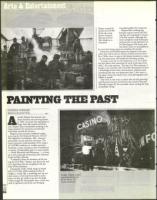
Shapiro created his
murals of Civil War
life for the newly
opened National
Museum of Civil
War Medicine in
Maryland.
PAINTING THE PAST
SUZANNE CHESSLER
Special to the Jewish News
A
natoliy Shapiro has learned a lot
about America since leaving Russia
in 1992. An artist who specializes in
larger-than-life murals and diora-
mas, Shapiro does considerable studying as he
begins projects for museums and specialty
attractions around the country.
Shapiro's most recently completed assign-
ment was for the National Museum of Civil
War Medicine in Frederick, Md., where he
placed four murals and four dioramas. The
center promotes understanding of the impact
of Civil War medicine on modern practice.
Frederick, a town witness to three Confederate
invasions, 38 skirmishes and two major battles
— South Mountain and Monocacy — is locat-
ed at the crossroads of America's first National
Road and first railroad.
"I wanted to show the hardness of life dur-
ing the Civil War," Shapiro says about the real-
istic depictions that he completed with the
help of two assistants.
Among the works, which range in length
from 35-75 feet while reaching 12 feet in
height, is Camp Life, a rendering that has sol-
diers close to tents and horse-drawn ambu-
lances as they get ready to go into the field.
Other images for that project show a field hos-
pital in operation and train cars bringing
TV
1/10
2000
84
Locally, Shapiro created
entertainment murals
for the Motor City
Casino in Detroit.