

tor of the Jewish Community Center in Detroit, and
Matilda Rubin, former JCC associate director, put their
heads together to discuss what could be done to give the
Detroit Jewish community a sense of purpose and
involvement.
"The country was just getting over the war, and there
were some feelings of hopelessness and despair because of
the Holocaust," said Rubin, now a therapist in private
practice in Huntington Woods. "There was a kind of
- 'what's the use attitude in our community. At the same
time, Israel had just been recognized as a state, and that
was a real plus for Jews everywhere.
"We went back and forth about whether we should
put our efforts here, or in Israel," she said. "Finally we
agreed that it was better to get our own community
involved — that would ultimately be good for us and for
Israel, too."
Although it had never been done before in the Detroit
area, Shaw, now of West Bloomfield, and Rubin thought
a Jewish book fair, consisting of books written by and
about Jews, would serve to educate the community and
increase its interest in, and appreciation for, Jewish
books.
The late Mrs. Pauline (Harry L.) Jackson, who was
active in many community organizations, served as chair-
person of the first Jewish Book Fair, which was held in
1951 in the old Jewish Community Center building
on Woodward Avenue in Detroit.
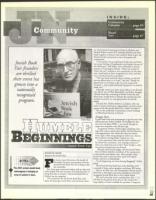
Jewish Book
_Fair founders
are thrilled
their event has
grown into a
nationally
recognized
program.
Scrappy Start
Irwin Shaw
e?4,
D
GINNIN
.&.awaraUr
a a
:
S
RONELLE GRIER
Special to the Jewish News
a a a al or
"•;
•
0
ap/
mamma ro
The JCC's annual Jewish book
extravaganza is bringing an
array of authors to town,
ri
or many metro Detroiters, the month of
November has been synonymous with the
annual Jewish Book Fair for as long as they
can remember.
But every great institution begins with an idea and
a few people with the creativity and determination to
bring that idea to fruition. The Jewish Book Fair in
Detroit was no exception.
The inspiration for the Jewish Book Fair came
about 50 years ago. Irwin Shaw, then executive direc-
It took hard work and perseverance to get the new idea
off the ground, Rubin recalled. The budget for that
first year was about $500 — not nearly enough to
meet event expenses, even 50 years ago.
To generate interest, Rubin began attending meet-
ings with various community leaders, Jewish educators
and organizations. For weeks she went out almost
every night, often toting along her infant son, Steven.
Her husband, George Rubin, helped out, too.
In the meantime, Shaw and the other members of
the Book Fair committee, were making contacts of
their own, both here and in New York. Finally, a cohe-
sive group of supporters was formed.
Because of the small budget, the first Jewish Book
Fair in Detroit relied on members of the community
to lend books and display cases. Many people volun-
teered their time to put up stock, pack and unpack
books, and serve as salespeople.
"In the beginning, we were shnoring [begging]," Rubin
joked.
That first book fair lasted two-and-a-half days and
consisted of three author-speakers and about 200 books.
Now in its 49th year, the Metropolitan Detroit Jewish
Book Fair is the largest and most prestigious nationally
recognized Jewish Book Fair in the United States.
This year's nine-day event, running from Nov. 1-12,
will feature 40 authors from all over the world with a
huge display of books available for purchase. Categories
1 1 / 3
2000
47