

Getting Worse
Pho to by Br ian Ha n d lc r/J TA
Analysts warn a wider war possible in inflamed Mideast.
GIL SEDAN
Jewish Telegraphic Agency
Jerusalem
A
s the violence in the West Bank and
Gaza Strip enters its second month,
there is a growing fear that it will esca-
late and embroil the entire region.
"It is absolutely mandatory that this conflict
should not turn into an interreligious war," Avishai
Braverman, president of Ben-Gurion University in
Beersheba, said this week. "If this turns into a reli-
gious war, we shall have an apocalypse."
Events of the past few days have provided ample
fuel for those who believe that the violence will
become a more wide-ranging religious conflict.
Millions in neighboring Muslim countries have
staged massive demonstrations against Israel and
the United States.
These protests have taken on a distinctly reli-
gious tone, with militants calling on the faithful to
rescue the Al-Aksa mosque, the holy shrine to
Islam on Jerusalem's Temple Mount.
The demonstrations in Egypt and Jordan could
threaten the stability of those regimes, which con-
tinue to maintain peaceful — albeit strained
relations with Israel.
Inside Lebanon
This week, however, Israel's most problematic neigh-
bor seemed to be Lebanon. Palestinian refugees liv-
ing in Lebanon staged demonstrations at the border
fence with Israel, reminding the world of a time
bomb still ticking away within Lebanon.
Lebanon's president, Emile Lahoud, spoke at last
week's Arab summit in Cairo of the need to allow
350,000 Palestinian refugees to return to the homes they
abandoned during Israel's 1948 War of Independence.
According to observers, he did not issue the call
because he is a champion of the refugees' rights, but
because he worries that the time bomb will explode
within his country instead of Israel.
Along with the refugee problem, Israeli officials
are also concerned about what Hezbollah's next
move may be.
This week, the Israel Defense Force warned of a
possible resumption of terrorist attacks along the
country's northern border.
The commander of Israel's northern forces, Maj.
Gen. Gabi Ashkenazi, said Monday that there is rea-
son to believe Hezbollah will try to open a second
front in addition to the ongoing clashes in the West
Bank and Gaza.
This second front was also on the mind of some
For more Mideast coverage, please see our Web site:
www.detroitjewishnews.com .
11/3
2000
26
Indeed, he believes that this is a specific goal of
Palestinian Authority President Yasser Arafat, who
would like nothing better than to see the broader
Arab world come to the aid of the Palestinian cause.
Luckily for Israel, Egypt and Jordan are not play-
ing along with Arafat.
Just as luckily, the untested new Syrian leader,
Bashar Assad, does not yet seem strong enough to
escalate the situation — although he may let
Hezbollah do the job for him.
Shamir warned that Israel should not rely for long
on the ability of Egyptian President Hosni Mubarak
and Jordan's King Abdullah to keep a lid on the
overheated streets of Cairo and Amman.
"There is a limit to their powers," warned Shamir.
He added that the worse the situation in the West
Bank and Gaza becomes, the more Mubarak and
Abdullah would have to bow to the demands of
hard-liners within their own countries.
Some experts, however, do not believe the current
violence will take on a regional dimension.
Observers like Ephraim Inbar of the Begin-Sadat
Center at Bar-Illan University said this week that
while people should treat the situation with caution,
they should not overreact.
"Israel should not be afraid of escalation," said Inbar,
who added that if Israel responds to attacks from
Palestinian gunmen, "There will be no escalation in the
neighboring Arab countries, because they, too, under-
stand that there are things" that demand a response.
Rising Leaders
Palestinians.
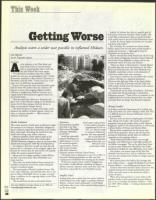
Israeli snipers take positions
Demonstrators marched
in the southern Jerusalem
this week in the West
neighborhood of Gilo on
Bank to of Ramallah
Oct. 29. They are ready
chanting: "Hezbollah,
to respond to Palestinian
hit Tel Aviv."
gunmen who have repeatedly
Israel has reportedly
shot at Gilo from the
pressed Washington to
predominantly Christian
add Lebanon to its list
village of Beit Jalla, just
of countries support-
800 yards across
ing terrorism, a move
a picturesque valley.
that would consider-
ably limit Lebanon's
business contacts with the United States.
The Israeli move is being seen as part of an effort to
force the Lebanese government to take steps that
would prevent Hezbollah from heating up the border.
If this does happen, Syria could be dragged into
the conflict. Israeli officials, including the deputy
defense minister, Ephraim Sneh, warn that they will
hold Syria responsible for any Hezbollah attacks.
Arafat Goal
Among those who caution that the current violence
could embroil the wider region is professor Shimon
Shamir, a former Israeli ambassador to both Egypt
and Jordan who is one of the nation's leading experts
on the Arab world.
And what would the Palestinians do if, indeed, the
Arab world does not come rushing to their aid? This
is a difficult question because Palestinian society is
not monolithic.
For one, there are forces competing for the leader-
ship. Along with Arafat, who enjoys the greatest
popularity among his people, there is also Marwan
Barghouti, leader of the armed militias, as well as the
militant leaders of Hamas and Islamic Jihad.
Beyond their competition for the hearts and
minds of the populace, there is also the fact that
among the Palestinian people there are different
responses to the ongoing violence.
"Many Palestinians believe there is not enough
shooting," said Oded Granot, Arab affairs analyst for
the Ma'ariv newspaper. "But on the other hand, there
are just as many Palestinians who believe that Arafat
should have handled the crisis differently, more wisely"
Ami Ayalon, the former head of the Shin Bet
domestic security service, said in a television inter-
view over the weekend that Arafat no longer controls
the territories.
He is among those who believe that younger and
more militant types — people like Barghouti and local
Hamas officials — are solidifying their power bases.
Ayalon's observation stood in sharp contrast to the
repeated statements by Israeli policymakers that
Arafat can order quiet in the territories within a
matter of hours.
When all is said and done, it is too early to tell
whether Arafat is still as powerful as some believe
him to be, or whether the present violence — like
the 1987-1993 intifada — is being orchestrated on
the street. ❑