

Life Beyond Life
A rabbi considers the fate of the soul and the mysteries of Judaism.
ELIZABETH APPLEBAUM
Apple Tree Editor
S
everal days before Rosh
Hashanah, Rabbi Elie
Kaplan Spitz met with a
congregant who was dying
of cancer.
The disease had come suddenly
upon the woman and was quickly
taking over her body. For the first
time in her life, she was unable to
attend High Holiday services.
Rabbi Spitz of Tustin, Calif,
blew the shofar for the sick woman,
then talked with her for a time.
Quiet at first, she began opening up
with great pleasure about her life, of
the joy she had known. She also
made clear that she had come to
terms with her own death and was
not afraid.
"She had come to see life in a
bigger way, to accept the fact that
death is a part of life," Rabbi Spitz
says.
So, too, has Rabbi Spitz learned
not to fear his own death. In fact,
he's become convinced that the soul
continues after this life.
In Does The Soul Survive? A
Jewish Journey to Belief in Afterlife,
Past Lives & Living with Purpose
(Jewish Lights Publishing, $21.95),
Rabbi Spitz writes on a variety of
topics. They range from traditional
and mystical Jewish understandings
of the world to come, Jewish views
on the "survival of the soul" and
exactly what the soul is, near-death
experiences and meetings with prob-
ably the best-known "medium" of
the day, James Van Praagh.
Rabbi Spitz, spiritual leader of
Congregation B'nai Israel in Tustin,
will speak about his book 6:30 p.m.
Sunday, Nov. 5, at the Jewish Book
Fair at the Jewish Community
Center in West Bloomfield.
Removing Doubt
Does the Soul Survive? began as one
of the rabbi's sermons. It developed
into a book as Rabbi Spitz found
that many in the Jewish community
were hungry for information about
the world to come.
The more he researched, the more
he became convinced that "beyond a
reasonable doubt," the soul survives.
"Once I was curious to know
more about these issues, more evi-
dence started coming toward me,"
he says. "Every time I gave a talk,
people came to tell me of their near-
death experiences or their mysterious
encounters. It fed into my growing
what we have been looking for.'"
Though skeptical, they began to
speak of the odd coincidences that
occurred after their daughter's death.
The more the couple talked, the
more they "grew to believe that the
soul of their daughter had survived,"
he says.
This was all he needed to know,
Rabbi Spitz says: "I was affirmed
by our conversation of the impor-
tance of the book."
Scholarly And Convincing
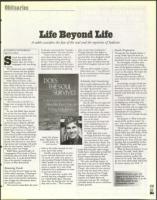
Rabbi Elie Kaplan
Spitz: "Beyond a rea-
sonable doubt, the
soul survives."
faith in this realm, beyond my con-
crete, day-to-day reality."
Initially, seeing his book in print
was an unusual experience, he says.
"So much of it deals with spirits, or
what [author] Elisabeth Kubler-Ross
called 'spooks' on the other side of
reality, and I don't have contact with
spirits or spooks. So it was a little
awkward to be a spokesman in terms
of survival of the soul."
Then an observant couple, who
recently had lost a daughter to can-
cer, visited Rabbi Spitz. Showing
them Does the Soul Survive?, he says
they said to him, "'This is exactly
Many works addressing the after-
life are filled with descriptions of
so-called "documented" cases
that allegedly prove reincarnation
or communication with the dead.
Very few fall into the realm of
intellectual study, and very few
are convincing.
Does the Soul Survive? approach-
es the subject in a scholarly man-
ner. Rabbi Spitz quotes extensive-
ly from Jewish texts, which
address reincarnation, the nature
of the soul and a concept cen-
tral to Judaism: the resurrec-
tion of the dead.
Consequently, his book will
prove enlightening even to
those weary of seeing yet
another treatise focusing on
the afterlife.
Rabbi Spitz also writes
movingly from his own expe-
riences, of the many astonish-
ing coincidences that came
after a loved one's death. For
example, one man had a pri-
vate nickname for his wife;
while delivering the man's eulogy,
Rabbi Spitz inexplicably uttered the
pet name — and relates the pro-
found impact this had on the
rabbi's understanding of death.
The only troubling chapter in
the book is the one in which Rabbi
Spitz recounts his session with Van
Praagh, who claims he can commu-
nicate with the dead. More than a
few have denounced Van Praagh
(Skeptic magazine did a complete
exposé), but Rabbi Spitz was
impressed, and says the "medium"
provided details he never could have
simply guessed.
Jewish Perspectives
Though the Van Praagh chapter is
vexing, Rabbi Spitz has done an
impressive job on the more scholarly,
specifically Jewish, aspect of the text.
He thoroughly considers what
various Jewish sources, including
some of the greatest scholars in his-
tory and the Talmud itself, have had
to say on the subject. He hopes this
will encourage the Doubting
Thomases of the Jewish world to
more seriously consider their own
faith.
Interestingly enough, Jewish per-
spectives on the world to come are
abundant, he says. So why do most
Jews only associate questions of the
afterlife with Kabbalah and mystical
thinkers?
"Clearly, Judaism's main focus is
on living this life righteously and
developing our relationship with
God," Rabbi Spitz says. "Therefore,
we have invested, and our sages have
invested, in writing about God's
expectations of us as gleaned
through Torah and through the gen-
erations."
But Judaism is "filled with state-
ments of the world to come," he
says. "Our tradition is grounded in
the belief in the survival of the soul.
"All of Israel has a place in the
world to come" — this is the open-
ing of Pirkei Avot (The Ethics of the
Fathers). A belief that our lives are
more than just chemical is the
grounding of a sense of Divine rela-
tionship and accountability in this
life." Details of the soul's fate must
remain a mystery, he says.
What we know of eternity "is not
concrete," he adds. "And I don't
know if it ever is. Just as God
remains a mystery, so does the
nature of our souls. The more you
go into your relationship with God,
the more mystery you find." ❑
E lie Kaplan Spitz will
at the Jewish Book Fair
Sunday, Nov. 5, at the
oomfIeld Jewish
Wit. Center.
11/3
2000
151