

Jewish Book Fair
DUTY BOUND from page
81
afterward. The author expertly weaves
these firsthand accounts with Tibbets'
comments into a story of three men
and a war.
It's not easy to spot in Duty, but
Greene actually is a junior — Robert
B. Greene Jr. His father, Robert B. Sr.,
died of diabetes complications at age
83 in 1998. Greene came home to
Columbus, Ohio, to be with him in
his last days.
His father, in the shoe business,
often spoke of Tibbets, whom he long
admired. The former pilot happened
to live in the area, maintaining
anonymity and a quiet life as one of
America's least-known war heroes.
Greene, who had wanted to meet
Tibbets for 20 years, wrote a column
about the latter's visit to the Ohio
History of Flight Museum, then got a
call from a friend of the fabled veter-
an. A meeting ensued, leading to an
ongoing friendship between Greene
and Tibbets.
Now 85, Tibbets likes to ear break-
fast at the local Bob Evans and watch
television. But at 29, he organized a
secret mission, trained fellow airmen
at a remote site in Utah and then went
to tiny Tinian Island in the Pacific.
From there, he flew the B-29 bomber
— called the Enola Gay after his
mother — that dropped the first
atomic bomb on Japan on Aug. 6,
1945.
After unloading the 10,000-pound
bomb, Tibbets made a diving turn
away from the area at an angle of 160
degrees. The blast still sent shock
waves that jolted the plane's crew.
Tibbets could even taste it — "like
lead," he recalled. "I looked at that
city ... and there was no city."
The explosion killed about 100,000
people immediately and many more
afterward. Another atomic bomb,
dropped on Nagasaki three days later,
effectively ended the war. The actions
prevented a probable Allied invasion
of Japan and saved countless American
— and Japanese — lives.
Incidents like these helped turn
most World War II veterans into what
has become known as "the silent gen-
eration." First, these same people
experienced the financial hardships of
the Depression, then the torments of a
raging war that killed millions world-
wide, "and most of them just didn't
want to talk about all that," Greene
points out.
In Duty, he digs deeply into the histo-
ry of the war and his father's back-
ground, perfectly meshing what he
learns about Robert Sr. with the story of
his own growing friendship with
Tibbets. He zeros in on one of the most
significant cultural divides in America:
between the deeply dutiful war genera-
tion and its more cynical and radically
individualistic descendants.
"As my dad lay dying, I could talk
to him and finally understand why the
war was so important to him," writes
Greene. "He had a strong sense of
honor and duty And he, like the other
vets, had never wanted to talk about
the war and his other troubles because
he didn't want to worry my mother
and [his children]. But now it's up to
us, the new generation, to ask and
find out about these things.
"As I listened to Tibbets later, I real-
ized anew that so many of us only
now, only at the very end, are begin-
ning to truly know our fathers and
mothers. It was as if constructing a
safety net for their children was their
full-time job, and that finally, as they
leave us, we are beginning to under-
stand the forces that made them the
way they were.
"Sitting with Tibbets, thinking of
my father in his bed just a few miles
away, it occurred to me that
Eisenhower was dead; Patton was
dead; Marshall was dead; MacArthur
was dead ... and here was Tibbets,
telling me, in the first person, the
story of how the great and terrible war
came to an end."
Greene says Tibbets has told him
war stories that the veteran never told
his own children because "it was too
painful to spill his guts to his family.
But now the later generations are
rightfully learning everything about
the old-timers."
Greene's father seemed to feel more
comfortable relating his war experi-
ences into a tape recorder, which his
son has listened to over and over
again.
"And I often come up with ques-
tions about certain things my dad said
that I didn't understand. So, I take the
tape to Tibbets and he usually explains
what Dad meant, and we continue to
discuss the war in general."
Greene says many people, who are
now recognizing Tibbets more often,
come up to war hero with tears in
their eyes and thank him for dropping
the bomb because it probably ulti-
mately saved a relative's life in the war.
"My own father, who had become an
infantry major, was being trained for
an invasion of Japan," Greene says.
As to the continuing debate over the
moral issue of whether the bomb
should ever have been dropped
because it killed innocent civilians,
Tibbets stands firm that it was neces-
sary to the war's strategy. He
would have wanted to drop
it on Germany if it had been
ready in time, and cites
Detroit as an example:
"If the Japanese had the
bomb and were going to
drop it on Detroit, do you
think it would have been
possible to separate the
defense plant workers from
the plants and save them,
along with other innocent
people in Detroit? Of course,
not. They all would have
been affected. This was war
... and the Hiroshima devas-
tation was part of war."
Greene became interested
in writing as a youngster
because he had "the urge to
tell people about things and
places and respond to the
requests of people," he says.
`And I felt comfortable telling
people on the written page."
At 17, he got a job as a copyboy
on the now defunct Columbus
Citizen Journal, cleaning paste pots
and putting ribbons on typewriters
in a "real city-room atmosphere."
Then he attended Northwestern
University's renowned journalism
school. At 23, he became a colum-
nist for the Chicago Sun-Times,
switching to the Chicago Tribune
in 1978. He also wrote for Esquire
and Life magazines.
As a broadcast journalist, he has
been contributing correspondent
for ABC's Nightline, and now gives
viewpoints on the daily news as a
weekly commentator on Chicago's
WGN radio.
Greene's best-selling books
include Be True to Your School,
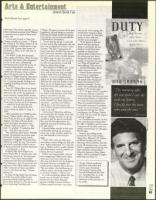
FATI I R
HIS SON
ANI) THU:. MAN
WHO WON
"The morning after
the last ineal I ever ate
with my ` ather,
I finally met the man
who won the war.'
Bob Grawe
Hang Time, Rebound: The Odyssey
of Michael Jordan and Good
Morning, Merry Sunshine. His first
novel, All Summer Long, was pub-
lished in paperback last spring. His
latest collection of journalism,
Chevrolet Summers, Dairy Queen
Nights, will be published in paper-
back early next year.
❑
Chicago Tribune syndicated
columnist and author Bob
Greene opens the Jewish
Community Center's 49th
Annual Jewish Book Fair 8:45
p.m. Saturday, Nov. 4, at the
JCC in West Bloomfield.
Admission is free and open to
the public.
I1/3
2000
93