

CONEY ISLAND
f a book that confronts death
head-on can be uplifting, Kate
Wenner has done it, in an auspi-
cious first novel, Setting Fires
(Scribner; 824).
The two fires referred to in the title
offer unseen sparks, that, amidst the
danger of consuming flames, light the
way to meaning for the main character
and her dying father.
Wenner's presentation of the theme
of teshuvah — and its impact on her
characters' lives — will touch readers
who've just finished their own process
of returning and forgiving.
In the book, Annie Fishman
Waldmas, a documentary filmmaker
rho lives on the Upper West Side of
Manhattan, receives two devastating
phone calls: One message is that her
country house is on fire, and soon after,
she learns that her father is potentially
very ill.
As she and her husband, a photo edi-
tor, hear more about the fire, their sus-
picions are raised that it was anti-
Semitic arson, possibly tied to several
other fires in the area in Jewish-owned
buildings.
At the same time, the news about her
father grows worse, and although their
relationship has been rocky at times,
she is drawn closely into his circle of
care. At the advice of a rabbi she seeks
out, Annie, who'd never before been
involved in Jewish life, tries to spend as
much time as possible with her father.
Rabbi Lowenstein emphasizes the
importance of coming to terms with
one's life at the end, of seeing life as a
gift, of forgiving and feeling forgiven.
With Annie's encouragement, her
very successful but distant father begins
to talk about his life — his "manufac-
tured" personality — with a certain
candor and self-awareness. He tells her
for the first time about a fire in his
childhood, that has haunted him for
more than 50 years.
As Annie seeks the truth about her
fire, the truth about her father's fire
shocks her, and gives her new insight
into her father's life and her own.
This is a story of rebuilding family, of
returning to Judaism; Wenner, an
award-winning television producer who
worked at ABC's 20-20 for 14 years,
also deals with social issues like anti-
Semitism as she tells the day-to-day
story of her characters' multi-layered
lives.
There's also a veil of mystery as
Annie, and later the FBI, investigates
the fire. Wenner is a skilled writer, and
pulls all these elements together well.
Although Setting Fires is fictional,
there are many parallels to the author's
life. Her father died in 1988 and before
his death, she grew close to him and
learned of a fire that brought him
much shame, and also of a real fire in
her country home.
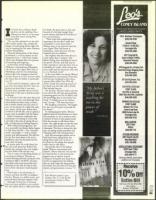
"These were such transformative
experiences for me that I really was
compelled to write about them,"
Wenner says, in an interview near her
own Upper West Side home in
Manhattan, where she lives with her
husband and two children.
She explains why she wrote this as a
novel rather than a memoir. "My
father's dying was a teaching for me in
the power of truth, and that may be
why I wanted to write the heart of it as
truthfully as I could, while setting the
story itself, and the characters who told
it, in a fictional world."
As her own father was dying, Wenner
videotaped her conversations with him,
and has just completed a short docu-
mentary film called Time With "Vly
Father, which she's showing as part of
her book tour this fall, and at Jewish
film festivals later on.
On the film, Wenner's father tells the
story of his fire. He also says good-bye,
expressing great love for his family and
the knowledge that in the end he was
loved. "I couldn't go out in a better
way," he says. "The time has come."
His daughter comments, "He fought
his way out of his past to provide for
our future."
In videotaping her father, Wenner
applied what she had learned as a televi-
sion producer, to try to create an envi-
ronment of trust so that people could
find the courage to talk about them-
selves. She urges people to take the time
now to get their parents' stories onto
videotapes. The keys to doing this, she
says, are asking simple questions and
"listening well, with real generosity."
And, she encourages people not to
hold back from asking about the
things they really want to know —
for those are the things that people
really want to talk about.
Around the time of her father's
death, Wenner reconnected with
Judaism. About teshuvah, she says she
has learned that "a real turning can
happen even at the last minute.
Dying can bring life into sharp focus
and be an opportunity for healing
that not only helps the dying person
face death, but also frees the next gen-
eration, and generations to come." ❑
Kate Wenner speaks 2 p.m.
Sunday, Nov. 5, at the Jewish
Community Center in West
Bloomfield.
Greek and American Cuisine
OPEN 7 DAYS A WEEK
154 S. Woodward, Birmingham
(248) 540-8780
Halsted Village
(37580 W. 12 Mile Rd.)
Farmington Hills
(248) 553-2360
6527 Telegraph Rd.
Corner of Maple (15 Mile)
Bloomfield Township
(248) 646-8568
4763 Haggerty Rd. at Pontiac Trail
West Wind Village Shopping Center
West Bloomfield
(248) 669-2295
841 East Big Beaver, Troy
(248) 680-0094
SOUTHFIELD SOUVLAKI
CONEY ISLAND
Nine Mile & Greenfield
15647 West Nine Mile, Southfield
(248) 569-5229
"My fiither's
dying was a
teaching for
me in the
power of
truth."
FARMINGTON SOUVLAKI
CONEY ISLAND
Between 13 & 14 on
Orchard Lake Road
30985 Orchard Lake Rd.
Farmington Hills
(248) 626-9732
— Kate nnner
NEW LOCATION:
525 N. Main
Milford
(248) 684-1772
UPTOWN PARTHENON
4301 Orchard Lake Rd.
West Bloomfield
(248) 538-6000
HERCULES FAMILY RESTAURANT
33292 West 12 Mile
Farmington Hills
(248) 489-9777
Serving whitefish, lamb shank,
pastitsio and moussaka
I. MIR MN NMI NM MI MI INN MIN NMI NM
I Receive
1 0% Off
I
i I Entire Bill I I
1
not to go with any other offer I
1
with coupon
Expires 12/30/2000
1
ME MN MI MINI MI =I NM MI NM INN
11/3
2000
85