
Focus On Photography
A Small Sampling
AMONG THE MANY JEWISH PHOTOGRAPHERS ADDING THEIR TALENTS TO
"DETROIT FOCUS
2000: A
FESTIVAL OF PHOTOGRAPHY" ARE THE FOLLOWING QUARTET.
Student Union Art Lounge, 530 South State
Street, Ann Arbor, Nov. 5-30. Sponsored by
the Hillel Foundation, the exhibit refers to the
36 righteous persons discussed in the Talmud.
"These are visual metaphors," explains
Weinstein, who will talk about the exhibit at
7 p.m. Thursday, Nov. 9, when Rabbi James
Stone Goodman of St. Louis, also a former
Oak Parker, will explain the concepts and
perform music he composed to go along
with the works.
One picture, titled The Lovers, is an abstract of
the faces of a man and woman at a concentra-
tion camp. Man with. Torah was planned to give
the sense of a Torah being returned to a camp.
'According to the Talmud, the world required
a minimum of 36 righteous individuals in order
to exist," Goodman explains. "In later kabbalis-
tic folklore, the 36 hidden ones have the poten-
tial to save the world. They appear when they are
needed, and one of them might be the Messiah. In
each generation, we look for them everywhere."
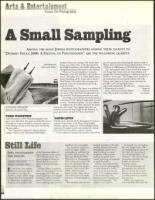
Todd Weinstein:
"Man with Torah."
SUZANNE CHESSLER
Special to the Jewish News
TODD WEINSTEIN
Todd Weinstein, a New York photographer who
grew up in Oak Park, has spent considerable time in
Germany as artist-in-residence, using his camera to
evoke feelings related to the Holocaust and Jewish
life since then.
"The Thirty-Six Unknown," almost abstract
images, will be at the University of Michigan
DAVID LEVIN
David Levin, director of the Biomedical Communi-
cations Department at the Henry Ford Health
System, spends a large part of his workdays taking
pictures of hospital events and routines for various
uses. His free-time photos capture vehicles.
Levin's photos of custom cars and hot rods will be
Still Life
JEWS, PHOTOGRAPHY
AND MEMORY.
DANIEL BELASCO
Special to the Jewish News
T n one photo, five soldiers
allt plant an American flag in
the sands of Iwo Jima. In
another, a single soldier hangs
a Soviet flag over the burned-
out Reichstag. Similarly rep-
resenting triumphalist views
0/27
000
part of a group show featuring the camera work of
Wayne State University alumni planned Nov. 6-27 at
736 Java, a coffeehouse at 736 Lothrop, Detroit.
"As I have gotten older, I have found that many of
the things that I enjoy now are those objects and
images that I found exciting as a child growing up in
Detroit," Levin says. "The images that I record are
of automotive and motorcycle culture. My wife,
Nancy, and I take in as many shows and races as
possible, and I am presently restor-
ing an old motorcycle. We also own
David Levin:
a Mustang and a truck."
Images of
Levin, who has a master's degree
Detroit's
from Wayne State University, has
car culture.
of the American defeat of
Japan and the Soviet victory
over Germany, these two
iconic images of victory in
World War II were both
taken by Jewish photogra-
phers.
George Gilbert juxtaposes
these two photographs on the
homepage of his Web site
(www.superexpo.com/cUggilb
ert.htm) to make a succinct
point: The Jewish contribu-
tion to photography has been
significant yet unrecorded.
As a corrective to this his-
torical oversight, Gilbert
independently published his
groundbreaking survey, The
Illustrated Worldwide Who's
Who of Jews in Photography in
1997, which documents 550
Jews who developed the art,
science and business of pho-
tography. They include Ben
S IlLahn „klfred Steiglitz,
Robert Frank, Diane Arbus,
Garry Winograd and Annie
Leibovitz, to name merely a
few.
But numbers alone do not
bespeak experience: The rela-
tionship between Jews and
photography cannot be so
simply reduced to name-'
dropping. Gilbert avoids
making any grand assess-
ments, preferring the Material
to speak for itself.
Indeed, "any unified field
theory of Jewish photography
is surely doomed to inade-
quacy from its very concep-
tion," A. D. Coleman wrote
in his recent essay "No
Pictures: Some Thoughts on
Jews in Photography." The
subject is too massive.
So instead, we can look to
the two images from 1945
as exemplifying an aspect of
the field: the interrelated-
ness of photography and
memory. "The camera helps
conscience shoulder the
burden of memory,"
Coleman writes.
The lucid directness of
photography has allowed
Jews to record the transfor-
mation of individual identi-
ty while preserving commu-
nal memory.
Gilbert eras inspired to
write the Who Who after dis-
Scanned image of the page. Keyboard directions: use + to zoom in, - to zoom out, arrow keys to pan inside the viewer.
October 27, 2000 - Image 104
- Resource type:
- Text
- Publication:
- The Detroit Jewish News, 2000-10-27
Disclaimer: Computer generated plain text may have errors. Read more about this.