
Focus On Photography
•
j11 1 11A 0Vaw:
s
\WiaA\ baMZbIti, AW‘W.i 4RMak,kWA.ar
WV& MI,„MLAW„
,,"
VekW •
0 Louis Stettner
INTERNATIONAL PHOTOGRAPHER LOUIS STETTNER'S VIBRANT IMAGES
CAPTURE MOMENTS OF EVERYDAY LIFE.
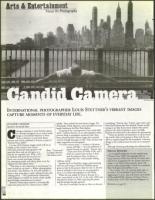
exhibit. They include his best-known image, The
Promenade, which captures a man stretched out on a
Special to the Jewish News
bench looking at the New York skyline.
"It's going to be a retrospective of my whole life's
oming to America, a Louis Stettner photo
work,"
explains Stettner, an art photographer whose
of a Jewish immigrant on an ocean vessel,
pictures
hang in prestigious museums and a free-
hangs in The Jewish Museum in New
lance
photojournalist
whose images have reached
York, is shown in a new book about
viewers through the pages of Life, Time, Fortune and
Stettner and will be exhibited in Pontiac as part of
other magazines and newspapers.
"Detroit Focus 2000."
"I've done various series — workers in factories,
It is one of 65 Stettner images which will be on
nature, still lifes = but the exhibition is
display at the Creative Arts Center,
mostly focused on people," Stettner says.
where the acclaimed photographer will
Above: "Pr omenade"
"They
come from all walks of life, and I
open the show and use the space as a
is perhaps Stettners
think
it's
a good cross-section. I don't
base for an extended visit. With a driv-
best-know n work.
look
for
dramatic
fires, accidents or
er, Stettner will travel the area for two
things
like
that.
I
take
people talking,
hours over several mornings, looking
walking, eating."
for interesting people and asking them to be the
Stettner, born in Brooklyn, began experimenting
subjects of a new photo series.
with
his craft using a Hawk Eye folding camera
"This show is very important to me because I've
given
to him by his parents when he was 13. By the
been invited by my peers — fellow photographers
time
he
enlisted in the Army, he was prepared to
and artists," says Stettner, 78, who still spends 12
serve
as
a combat photographer in the Pacific.
hours a day, seven days a week, taking pictures and
When
the war ended, he lived in Europe for a
making prints. "This [professional connection]
time, moved back to the U.S. in the early 1950s and
rarely happens in today's art world, which usually
relocated to France in 1990, capturing the places
goes through institutions and curators."
and the people through pictures.
Stettner, whose career interest is everyday life,
"My way of working is being out there to discover
chose the photos for his "Detroit Focus 2000"
SUZANNE CHESSLER
C
wiay
10/27
2000
90
something," Stettner says. "I don't come with a pre-
fixed idea because then I'm limited. There's an old
saying in art that if you know clearly what you're
going to do, then it's going to turn out badly
because you don't give it any chance for spontaneity.
"There's an element of excitement in never know-
ing exactly what you're going to find, and I'm out
there to surprise myself or be astonished. I discover
things in the world around me and try to interpret
that."
Although advancing technology has influenced the
SPECIAL, HONORS
At a kickoff celebration for the month-long
"Detroit Focus 2000" photography festival,
Louis Stettner will be one among 10 artists who
will receive recognition for the impact they have
made on the field of photography. Each will
receive a glass paperweight created by renowned
New -York glass artist Sydney Cash.
The Sunday, Oct. 29, opening-night gala, to
be held at the Southfield Center for the Arts
beginning at 5 p.m., also will honor Gere Baskin
of Bloomfield Hills, director of Detroit Focus
Gallery from 1979-1991; Howard Bingham of
HONORS on page 94
Scanned image of the page. Keyboard directions: use + to zoom in, - to zoom out, arrow keys to pan inside the viewer.
October 27, 2000 - Image 102
- Resource type:
- Text
- Publication:
- The Detroit Jewish News, 2000-10-27
Disclaimer: Computer generated plain text may have errors. Read more about this.