

News from Israel
An informative evening with
a General from Israel
WEDNESDAY, OCTOBER 25, 2000
7:30 P.M.
Jewish Community Center of Metropolitan Detroit
D. Dan and Betty Kahn Building
Eugene and Marcia Applebaum Jewish Community Campus
Marion and David Handleman Hall and Auditorium
6600 W. Maple Rd., West Bloomfield
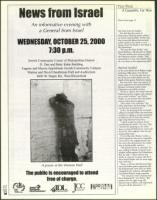
A prayer at the Western Wall
The public is encouraged to attend
free of charge.
10/20
2000
16
gwish 2
mm unity
uncll=
.11,, ■rtulmnay ,nwr
, rf Motwolitan flctmit
Fi.j3C:7 ■ 1 1
A Ceasefire, For Now
UNITY from page 15
that Israel must be tougher.
Few feel that the scores of
Palestinians killed by Israeli soldiers
are Israel's responsibility. Neither are
they concerned about international
public opinion that tends to turn
against Israel the harder it hits back at
the Palestinians.
"We must hit them harder," says
David Shalom, a 48-year old car dealer.
"Not the civilians, but we must teach
the Palestinian police a lesson. They
started this at a time when Barak want-
ed to sit down at the negotiating table."
Reprisals Justified
In the more liberal Emek Refaim neigh-
borhood, coffee shops were full last
Friday, Oct. 13, the day after the mur-
der of the two Israeli soldiers and the
Israeli strikes against Palestinian targets.
But even here, there were plenty of
peace supporters who backed Barak's
decision to launch strikes inside
Palestinian-controlled territory.
"As far as I know, the strikes were on
Palestinian police targets, and attempt-
ed to avoid civilians," says Esther
Nadav, an accountant from Jerusalem
and an ardent peace supporter.
"After what I saw yesterday," she
adds, referring to the lynchings, "I did
not feel that it bothered me."
In fact, the lynching of the two Israeli
soldiers so shocked Nadav that she found
herself even willing to consider proposals
by Rehavarn Ze'evi, from the extreme
right-wing National Unity Party.
"I don't accept his policies about
transferring the Arabs," she says. But
I heard him speaking on the radio
about cutting off Palestinian water and
electricity, and suddenly what he was
saying made sense."
On the flip side, Shalom Cohen, a
Likud supporter who owns a specialty
wine store in the neighborhood, also
has views that demonstrate the confu-
sion in Israeli public opinion.
"We should not be so merciful," he
says, calling on Barak to launch even
tougher strikes against the Palestinians.
But, he adds, "I don't believe that
Arafat is a partner in peace. But he is
their elected leader and we must nego-
tiate with him."
Yaron, a 29-year-old-electrical engi-
neer and ardent peace supporter; says
his fundamental views have not been
changed by the violence, although he
too backed Barak's tough response.
"The romantic vision of peace may
have disappeared," says Yaron, "But
maybe now the right wing will
become more realistic and understand
the price or the alternative."
❑