

WOUVER1140
"took
She
a+
her
imat 4-14 1,
ale Wo
Holiday
Eubbub
erusalem's abuzz
as the joyous festival
of Sukkot nears.
tt Where 4IficArofte'
°Where 5 Ne
1M9 her
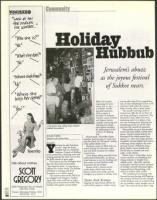
A Jerusalem shop selling Noyai Sukkah
(sukkah decorations).
SUSAN TAWIL
Special to the Jewish News
Jerusalem
Talk about clothes...
SCOTT
GREGORY
10/13
2000
50
6525 Telegraph Rd. at Maple
248-203-9050
Hours: Monday-Friday, 10-8
Saturday, 10-6
am-bam-ba-am! Yarn-bam-
ba-am!" sings the burly,
bearded man in a beautiful
baritone. Crowds of children
swirl around him, clutching coins and
waiting patiently for their turn to buy
his fluffy clouds of spun sugar.
The scene is not the Michigan State
Fair, but the streets of Jerusalem.
"Yam-bam-ba-amm," it turns out, is
Hebrew for cotton candy. The holiday
of Sukkot is coming, and all of
Jerusalem is in a festive mood.
The narrow streets of the Old City
are clogged with shoppers. Vendors
hawk their wares until late at night,
selling the accoutrements of the chag,
holiday. Men gather around tables
filled with etrogim,
inspecting the specie
citron fruit in sear—
a mehudar, ritually
beautiful specimen.
Others squint at
branches of hadassim
(myrtle), arovot (willow)
and lulavim (palm),
carefully examining and
selecting the compo-
nent species necessary
for performance of the
mitzvah of "shaking
lulai
Several stands ,ell bundles of pine
branches, bamboo poles or woven cane
mats for schach, the "all natural" roofing
of the sukkah (Sukkot hut).
Hardware stores are filled with cus-
tomers buying the hammers, nails,
nuts and bolts necessary for sukkah
construction.
Linen shops, selling beautiful white
embroidered tablecloths, are doing a
brisk business; so are the clothing and
shoe stores, as local families outfit
themselves for the holiday.
Busiest of all, it seems, are the
candy shops, which cater to the
famous Israeli sweet tooth, and the
indulgences of parents at holiday time.
Tastes And Aromas
Tapping the equal Israeli affinity for
nosh (snack), popcorn vendors scoop
out bag after bag of hot, popped ker-
nels, as other shopkeepers scurry to fill
customers' bulk orders for various
other crunchy, salty or spicy treats.
The mouth-watering smell of
roasted nuts fills the air in front of
one shop, pulling in customers. The
merchant's slick, albeit low-tech,
marketing tactic is to direct a fan
over the roasting nuts, blowing the
tantalizing aroma out of the store
and into the nostrils of passersby.
Many tables set up in the crowded
streets sell noyai sukkah, sukkah deco-
rations. Popular posters feature the
blessings of the arbah minim (four
species, i.e., lulav and etrog), pictures
of gedolim (revered rabbis) and various
renderings of the ushpisin, the seven
spiritual "guests" (Abraham, Isaac,
Jacob, Moses, Aaron, Joseph and
David) that are invited, one each
night, to the sukkah.
Plastic fruit is a big seller, as are
various mobiles and sparkling foil
thinga-mabobs to dangle from
sukkah roofs. Absurdly, chasidic
and yeshiva families snatch up boxes
of twinkly colored Christmas lights,
imported from Hong Kong, with
which to bedeck their sukkot.
The markets are swarming with
housewives purchasing still-flopping
fish, freshly shechted (ritually slaugh-
tered) chickens and, as a special treat
for the holiday, rarely bought cuts of
beef. The national Israeli sport, hag-