
At The Movies
`Solomon And Gaenor'
A Welsh "Romeo and Juliet" with a Jewish
twist comes to the Detroit Film Theatre.
NAOMI PFEFFERMAN
Special to the Jewish News
S
everal years ago, filmmaker
Paul Morrison wandered up
and down the green mining
valleys of South Wales, with
his tape recorder in tow.
He sought out senior citizens who
could reminisce about the immigrant
Jews who once lived in the staunchly
Christian mining communities, who
set up synagogues in the back rooms
of pubs or post offices.
In modest sitting rooms, he listened
raptly as the seniors spoke of Jews they
had known, of love and courtship and
of relationships that had "crossed the
line."
The interviews helped to inform
Morrison's Welsh-Yiddish-English lan-
guage drama, Solomon And Gaenor, a
1999 Oscar nominee for Best Foreign
Film that will be screened at the
Detroit Film Theatre Friday-Sunday,
Oct 13-15.
The movie, set in 1911, is the star-
crossed romance of a Welsh girl and a
Jewish boy who tries to "pass" as gen-
tile. The Jewish character is, in a way,
Naomi Pfefferman is entertainment
editor at the Jewish Journal of Greater
Los Angeles. Peter Ephross of Jewish
Telegraphic Agency contributed to this story
Review
"Two households, both alike in
. From ancient grudge break to
new mutiny." So begins Shakespeare's
Romeo and Juliet, a tale that has since
been reinterpreted many times over.
Oscar-nominated film Solomon and
Gaenor creatively reworks the classic
tragedy of love-thwarted-by-prejudice,
setting the scene in turn-of-the-centu-
ry Wales. In this version the star
cross'd lovers are Solomon, the son of
Jewish immigrants, and Gaenor,
daughter of a working-class Welsh
family.
Solomon (Joan Gruffudd), the
handsome eldest son of a merchant
10/6
2000
90
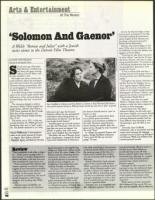
Loan Gruffedd as Solomon and Nia Roberts as Gaenor in Paul Morrisons filfn about a
star-crossed romance between a Welsh girl and a Jewish boy who tries to 'pass" as gentile.
Morrison's alter ego; the fictional
Solomon reflects his own internalized
ambivalence about being Jewish, an
ambivalence he believes "runs far back
into Anglo-Jewish history"
Morrison grew up in north London,
just after the Holocaust, with the mes-
sage that one must not appear "too
Jewish" in public, that a Jew must
seem "more English than the English."
His father, the son of Russian immi-
grant shopkeepers, changed the family
name from Moskovitch to Morrison;
family, has gone to the neighboring
village as a "pack man" selling textiles
door to door. He meets Gaenor (Nia
Roberts) and her disarming shyness
entices him. Solomon conceals his
true Jewish identity by introducing
himself as. Sam Livingston, an
Englishman, thus beginning a rela-
tionship founded on deception.
The year is 1911 and anti-Semitic
riots are soon to break out. This is the
surprising factual backdrop of
Solomon and Gaenor.
There was indeed a Jewish immi-
grant community in Wales in the
early part of the 20th century, but it
is a little-known piece of history that
writer/director Paul Morrison discov-
the director himself tried to "pass" as
Aryan as a boy.
He attended a school where there
was a Jewish quota and where
swastikas were sometimes scribbled on
the walls. Morrison sang Christian
hymns during the school's daily reli-
gious service, though he only mouthed
the word "Jesus."
In college, he practiced Eastern reli-
gions, though Buddhist meditation
"never quite felt like my own lan-
guage," he says.
ered while researching a documentary
on British Jewish identity. It inspired
the opening image of the film, of a
black-coated, bearded Jew striding
over the mountains and through the
slag heaps.
Indeed, Morrison's visual represen-
tation of the economically strained
Welsh countryside is nothing short of
poetic. When Solomon makes a suit-
or's gift to Gaenor of a bright red
cloth, the fabric is a shocking splash
of color in an otherwise somber gray
and green landscape. It is also a sym-
bol of youthful passion that enrages
Gaenor's repressive father.
Solomon, too, is in unspoken con-
flict with strict parents. One of the
And so the director began a slow
journey back to Judaism in his 30s,
eventually making documentaries
about English-Jewish identity and
founding a discussion group for
British-Jewish filmmakers.
Solomon And Gaenor began, in the
early 1990s, after he chanced to visit
an exhibition on the now-defunct syn-
agogues of South Wales.
"I had had no idea there were Jews
in those valleys," marvels the 55-year-
old writer-director, who also is a prac-
ticing psychotherapist. "It struck me as
a fascinating juxtaposition that Jews of
my grandparents' generation lived
among the miners.
"It was a culture clash and also a
synergy, because both groups were sur-
vivors and both were Old Testament
people."
To heighten the drama, Morrison set
his film during the Tredegar riots, a
1911 pogrom against Welsh-Jewish
shops. For the look of the film, he
turned to the simple, harshly beautiful
photographs of Roman Vishniac, who
captured the Jewish communities of
Poland before World War II.
Morrison, who does not speak
Welsh or Yiddish, had to employ con-
sultants to help him direct segments of
the film in those languages.
David Horovitch, who plays
Solomon's father, was the only actor
who knew Yiddish, and veteran British
Jewish actress Maureen Lipman, who
portrays Solomon's mother, had the
most difficult time learning it, even
threatening to quit the film at one
point.
Ironically, loan Gruffudd
(Solomon), who is not Jewish, had the
easiest time learning the language —
perhaps because he grew up bilingual
and because Welsh and Yiddish both
contain guttural sounds.
most devastatingly effective scenes in
the film occurs when Solomon,
secretly plotting to run off with
Gaenor, asks his father Isaac (David
Horovitch) for a blessing. In a superb
moment of Old Testament pathos,
patriarch Isaac refuses Solomon's
plaintive request.
Although the film succeeds in jerk-
ing many a tear, the unfortunate lapse
in the film is the representation of
our two lovers. Solomon and Gaenor,
overly tentative and remote, often
seem to be more character-types than
characters.
What's more, we don't necessarily
like Solomon all that much. His con-
flict may be palpable. But he lacks the
Scanned image of the page. Keyboard directions: use + to zoom in, - to zoom out, arrow keys to pan inside the viewer.
October 06, 2000 - Image 122
- Resource type:
- Text
- Publication:
- The Detroit Jewish News, 2000-10-06
Disclaimer: Computer generated plain text may have errors. Read more about this.