
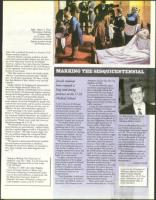
Right: Robert A. Thom:
"Semmelweis: Defender-
of Motherhood"
oil on canvas, 1948.
Semmelweis pioneered
hygienic practices during
the birthing process.
cides with a weekend devoted to a reunion of all
former medical students.
Howard Markel, associate professor of pedi-
atrics and communicable diseases and the direc-
tor of the Historical Center for the Health
Sciences, explains that items from the Taubman
Medical Library on exhibit at the U-M Museum
of Art represent vivid artistic plates from its col-
lection of rare books.
"One that comes to mind is the Vesalius book,
which is a very famous anatomy atlas," Markel
says. "It's all those musclemen. We have, I think,
four first editions of that, which is very rare and
valuable."
Markel explains the background represented in
one of the images loaned by Phizer Inc.
Semmelweis: Defender of Motherhood, oil on canvas,
shows the doctor who pioneered hygienic practices
during the birthing procesS. His actions paved the
way for the study of communicable diseases.
Semmelweis had noticed that newborns had a
better chance of survival if handled by people who
washed their own hands, and he tried to introduce
appropriate procedures. Because his ideas were so
different, he met with tremendous opposition.
Other paintings in the series completed by
Robert A. Thom commemorate the founding of
the American Medical Association, the conquest of
yellow fever and the development of pharmaceuti-
cal education. There's even a work that shows an
old pharmacology lab at U-M.
"We planned the museum show to address the
nexus between art and medicine," explains Metzl,
who has a medical degree as well as a doctorate in
American culture. "We hope to give insight into
the way medicine shapes the conceptual frame-
work of the body and also how culture shapes
medicine.
"We wanted to demonstrate historical sensibili-
ties and themes of innovation in medicine.
Through the artwork on exhibit, we intended to
tell a more complex story than diagnosis and
cure."
❑
"Seeing Is Healing? The Visual Arts of
Medicine" runs Oct. 7-Dec. 3 at the University
of Michigan Museum of Art in Ann Arbor.
(734) 764-0395.
On May 6-7, 2001, the Cohn-Haddow
Center for Judaic Studies at Wayne State
University is planning an international confer-
ence on Jews and medicine, co-sponsored with
the Wayne State University School of
Medicine. For more information, contact the
Cohn-Haddow Center at (313) 577-2679.
Jewish students
have enjoyed a
long and strong
presence at the U-M
Medical School.
As the University of Michigan
Medical School holds sesquicen-
tennial celebrations on campus
and around the country, the
achievements of its Jewish gradu-
ates and faculty fit into the mix of
breakthrough advances in medical
education, research and treatment.
"The medical school, since its
inception in 1848 and the first
graduating class of 1851, has always
been an innovator in the develop-
ment of new methods for educating
physicians and scholars," says cur-
rent dean Allen S. Lichter, M.D.,
the first Jewish dean of the school.
"We continue to use our
resources and the vision and new
ideas of succeeding generations to
`raise the bar,' working with our
colleagues around the country and
around the world to improve the
health of our community."
The place of Jewish doctors in
the development of the medical
school has been noted by Howard
Markel, M.D., Ph.D., associate
professor of pediatrics and com-
municable diseases and director of
the Historical Center for the
Health Sciences.
"There's long been a Jewish pres-
ence at U-M, not just at the med-
ical school," says Markel, author of
Quarantine: East European Jewish
Immigrants and the New York City
Epidemics of 1892.
"It was one of the first major
universities accepting Jewish stu-:
dents, long before schools like
Harvard and Yale were doing it.
[Acceptance] is true of a whole
host of representative minority
groups, and that's really part of the
bigger picture of the university as a
public institution." .
Among the most notable Jewish
doctors working at U-M have
been Jerome Conn, an endocrinol-
ogist who did research into the
retention of salt, and Edgar K.ahrt,
the neurosurgeon fictionalized in
the novel Magnificent Obsession by.
Lloyd Douglas and-the son of
famed architect Albert Kahn.
Markel, who graduated from
Southfield-Lathnip High School
and had his bar mitzvah at B'nai
David, has been involved in organ-
izing many of the activities that
pertain to the 150th anniversary
celebration, which has spanned
two years. There will be a massive
reunion on the weekend of Oct.
13, and attendees will represent
the 18,000 doctors who have grad-
uated U-M, more alumni than any
other American medical school.
Markel edited a special issue of
the Journal of the American Medical
Association entirely devoted to
research and traditions at the med-
ical school. He reports there are
geneticists workina on the breast
cancer gene, which b has shown to
be associated more commonly but
not exclusively with women of
Ashkenazi Jewish descent.
"There aren't many American
medical schools that are 150 years
Dr. Alan Lichter: First Jewish
dean of the University of
Michigan Medical School.
old so we take great pride in this,"
. says Markel, who earned his
undergraduate and medical degrees
at U-M. "We are very happy that
the medical school has been of
service to the people of Michigan
and beyond, not just by taking
care of patients and not just by
teaching but also by advancing
what we know about disease and
how to prevent it.
"The celebration is a chance to
reflect on this glorious past and
remind us that we've got a lot of
work to do, and we're excited
about doing it."
— Suzanne Chessler
A reunion for University of
Michigan Medical School
alumni will be held the
weekend of Oct. 13-15. For
more information, call the
Sesquicentennial office at
(734) 763-5472.
YAtil-MMa alraMekEMAla
Scanned image of the page. Keyboard directions: use + to zoom in, - to zoom out, arrow keys to pan inside the viewer.
October 06, 2000 - Image 113
- Resource type:
- Text
- Publication:
- The Detroit Jewish News, 2000-10-06
Disclaimer: Computer generated plain text may have errors. Read more about this.