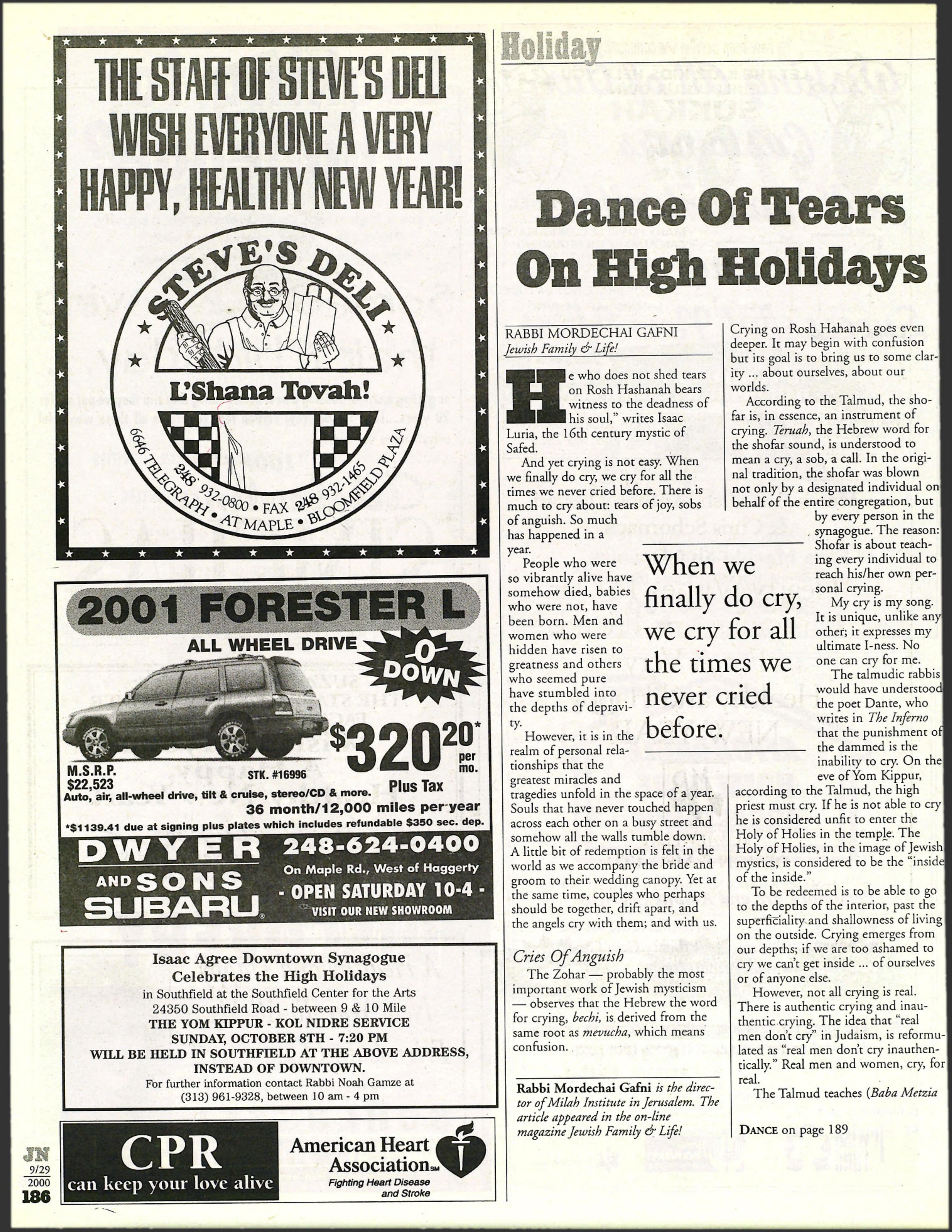
THE STAFF Of STEWS OW
WISH EVERYONE A VERY
HAPPY, ELM NEW YEAR!
Dance Of Tears
On High Holiday's
RABBI MORDECHAI GAFNI
Jewish Family & Life!
n
ALL WHEEL DRIVE
$32 029:
M.S.R.P.
$22,523
mo.
STK. #16996
Auto, air, all-wheel drive, tilt & cruise, stereo/CD & more.
Plus Tax
36 month/12,000 miles per -year
*$1139.41 due at signing plus plates which includes refundable $350 sec. dep.
D W Y E R
248-624 04_00
On Maple Rd.,. West of Haggerty
ANDS iNi
- OPEN SATURDAY 10-4
OUR NEW SHOWROOM
SUBARU!.
Isaac Agree Downtown Synagogue
Celebrates the High Holidays
in Southfield at the Southfield Center for the Arts
24350 Southfield Road - between 9 & 10 Mile
THE YOM KIPPUR - KOL NIDRE SERVICE
SUNDAY, OCTOBER 8TH - 7:20 PM
WILL BE HELD IN SOUTHFIELD AT THE ABOVE ADDRESS,
INSTEAD OF DOWNTOWN.
For further information contact Rabbi Noah Gamze at
(313) 961-9328, between 10 am - 4 pm
9/29
2000
186
CPR
can keep your love alive
American Heart
Association.
Fighting Heart Disease
and Stroke
e who does not shed tears
on Rosh Hashanah bears
witness to the deadness of
his soul," writes Isaac
Luria, the 16th century mystic of
Safed.
And yet crying is not easy. When
we finally do cry, we cry for all the
times we never cried before. There is
much to cry about: tears of joy, sobs
of anguish. So much
has happened in a
year.
People who were
so vibrantly alive have
somehow died, babies
who were not, have
been born. Men and
women who were
hidden have risen to
greatness and others
who seemed pure
have stumbled into
the depths of depravi-
LT
Crying on Rosh Hahanah goes even
deeper. It may begin with confusion
but its goal is to bring us to some clar-
ity ... about ourselves, about our
worlds.
According to the Talmud, the sho-
far is, in essence, an instrument of
crying. Teruah, the Hebrew word for
the shofar sound, is understood to
mean a cry, a sob, a call. In the origi-
nal tradition, the shofar was blown
not only by a designated individual on
behalf of the entire congregation, but
by every person in the
synagogue. The reason:
Shofar is about teach-
ing every individual to
reach his/her own per-
sonal crying.
My cry is my song.
It is unique, unlike any
other; it expresses my
ultimate I-ness. No
one can cry for me.
The talmudic rabbis
would have understood
the poet Dante, who
writes in The Inferno
that the punishment of
the dammed is the
inability to cry. On the
eve of Yom Kippur,
according to the Talmud, the high
priest must cry. If he is not able to cry
he is considered unfit to enter the
Holy of Holies in the temple. The
Holy of Holies, in the image of Jewish
mystics, is considered to be the "inside
of the inside."
To be redeemed is to be able to go
to the depths of the interior, past the
superficiality and shallowness of living
on the outside. Crying emerges from
our depths; if we are too ashamed to
cry we can't get inside ... of ourselves
or of anyone else.
However, not all crying is real.
There is authentic crying and inau-
thentic crying. The idea that "real
men don't cry" in Judaism, is reformu-
lated as "real men don't cry inauthen-
tically." Real men and women, cry, for
real.
The Talmud teaches (Baba Metzia
When we
finally do cry,
we cry for all
the times we
never cried
before.
However, it is in the
realm of personal rela-
tionships that the
greatest miracles and
tragedies unfold in the space of a year.
Souls that have never touched happen
across each other on a busy street and
somehow all the walls tumble down.
A little bit of redemption is felt in the
world as we accompany the bride and
groom to their wedding canopy. Yet at
the same time, couples who perhaps
should be together, drift apart, and
the angels cry with them; and with us.
Cries Of Anguish
The Zohar — probably the most
important work of Jewish mysticism
— observes that the Hebrew the word
for crying, bechi, is derived from the
same root as mevucha, which means
confusion.
Rabbi Mordechai Gafni is the direc-
tor of Milah Institute in Jerusalem. The
article appeared in the on-line
magazine Jewish Family Life!
DANCE on page 189
Scanned image of the page. Keyboard directions: use + to zoom in, - to zoom out, arrow keys to pan inside the viewer.
September 29, 2000 - Image 186
- Resource type:
- Text
- Publication:
- The Detroit Jewish News, 2000-09-29
Disclaimer: Computer generated plain text may have errors. Read more about this.