
Community
Spirituality
ol Vii en
W
B'nai Moshe votes to include women
in the synagogue minyan.
SHELLI LIEBMAN DORFMAN
STAFF WRITER
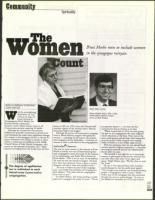
Rabbi Elliot Pachter
IV
ith the overwhelming
declaration of "yay"
votes at an Aug. 24
board meeting at
Congregation B'nai Moshe, the
Detroit Jewish community
became a town whose women count in all
Conservative services requiring 10 adults.
Although the Conservative movement's
Rabbinical Assembly Committee on Jewish Law
and Standards has made many significant changes
for women in the synagogue service in the last 45
years, Detroiters have chosen to accept or reject
them at varied pace and different levels. Rabbi
Daniel Nevins of Adat Shalom Synagogue, who
serves on the national committee, says, "Aliyot
(honors of reading from the Torah) were the first
The degree of egalitarian-
ism is individual to each
Detroit-area Conservative
congregation.
Nancy Kaplan leads a Eilu v' Eilu
Conservative women's minyan
service at Beth Shalom.
barrier to fall, (in 1955,) since the Talmud itself
provides support of the women's aliyot. Minyan
and prayer leader took longer."
Although 86 percent of Conservative congrega-
tions in North America support full egalitarian
services — including Torah honors, the minyan
and synagogue service leadership — inclusion of
women in each is individual to the congregations.
IndividualkCharacter
The vote to count women in the minyan at B'nai
Moshe is merely one way of demonstrating that
each congregation meets the needs of the majority
of its membership, says Rabbi Elliot Pachter of
B'nai Moshe. "This is not an issue of inevitability.
We can't say this was bound to happen. All shuls
have their own character. Ours is about a certain
character and this is what our members want."
"We have to follow the lead of the congrega-
tion," says Rabbi David Nelson of Congregation
Beth Shalom. "The rabbi and the congregation
have to be in sync."
For Rabbi Nelson, that means leading a totally
egalitarian synagogue for nearly 30 years. "There's
no question about it — we were the first
Conservative shul in Detroit to do that.
"When I came here in 1972, we were giving
the girls in the congregation the same religious
school education as the boys. They were in the
same youth group, and the boys were having bar
mitzvah services while the girls were reading
Psalm of Psalms in a late Friday night service."
With the sentiment that "no one should block
another person's religious aspirations," a Saturday
morning bat mitzvah service was implemented
shortly after he came.
"We decided it was right for us to encourage
women to participate in the service, and not just
one time when they were 13 but again and
again," Rabbi Nelson says. "We like them to read
the Torah."
He says it was expected that some members
would disapprove, but he recalls most agreed.
"The changes were made by very forward-looking
people, a congregation with a vision," Rabbi
Neslon says of the synagogue that has continued
through the years to make changes. "As soon as
the Rabbinical Assembly (in 1973) said women
9/29
2000
R25
Scanned image of the page. Keyboard directions: use + to zoom in, - to zoom out, arrow keys to pan inside the viewer.
September 29, 2000 - Image 107
- Resource type:
- Text
- Publication:
- The Detroit Jewish News, 2000-09-29
Disclaimer: Computer generated plain text may have errors. Read more about this.