

in Jewish Education
Exploring Our Pathways
Higher education tackles the challenge of Jewish studies.
Q: What will it take to make Jewish
learning exciting, meaningful and
ongoing for all ages?
more and more students, ways to
explore new subjects and the com-
plexity of Israeli life.
DR. STEVEN WEILAND
Special to the Jewish News
Far-Reaching Goals
ewish studies as an academic
field in American higher edu-
cation has grown substantially
in recent years. There is more
variety and vitality in Jewish studies
scholarship and courses than ever
before.
If Michigan State University, where I
teach, is representative, Jewish studies will continue to grow.
American Jewish communities are recognizing the value of rigorous
classroom study of Hebrew, Jewish history and literature, modern
Jewish experience in the diaspora, the Holocaust and its aftermath,
and Israeli society. Nothing can match reading and writing about, and
discussing, such subjects for guiding students toward an understand-
ing of the entire range of Jewish civilization.
For Jewish students, there is the additional benefit of opportunities
to reflect on what it means to be Jewish, particularly at a time when
they will make important choices in their lives.
Only a small number of Jewish undergraduates in America are
majoring in Jewish studies. Still, many take such courses as a part of a
"minor" in Jewish studies (or as we call it at MSU, a "specialization").
Those who complete the program deserve commendation because as
the requirements of popular majors have increased, it has become
more and more difficult for students to make scheduling space for
minors like Jewish studies. Even so, Hebrew enrollments at MSU
have more than tripled in the past few years, a particularly good sign
of student interest in launching their undergraduate careers with a
commitment to Jewish life and ideas.
Enrollments in other courses have increased as well, reflecting
interest among non-Jewish students (MSU enrollments, like those in
Jewish studies courses at other research universities, are about evenly
divided in this regard). And, as in Jewish studies programs across the
country, MSU finds great student and public interest in the
Holocaust. Opportunities for study in Israel appear to represent, to
IT
The promise of Jewish studies in the
university, however, should not
obscure the need for attention to
critical matters, such as attracting
students to seemingly less appealing
but essential knowledge of the great
Jewish texts, including the Hebrew
Bible.
Also note that education about
the Holocaust, while certainly meriting the attention it is now getting,
cannot be the primary focus of any academic program aiming to rep-
resent the diversity of Jewish experience, both ancient and modern.
Teaching and learning about Israel, too, is a demanding curricular
task, when it must be woven into the complex web of culture and pol-
itics that is the Middle East.
Institutionally, Jewish studies programs must compete for resources
with better-established academic fields, and at a time when many uni-
versities, like MSU, give priority to career-oriented activities.
What is the future of Jewish studies? In a recent essay in the
Forward newspaper, sociologist Morton Weinfeld of McGill
University in Montreal proposed "Birthright Jewish Studies" to com-
plement the Birthright Israel program. Founded in 1999 by Jewish
Renaissance Media Chairman Michael Steinhardt, whose group pub-
lishes the Jewish News, Birthright Israel provides expense-paid trips to
Israel for young Jews. Modest scholarship support for students who
enroll in Jewish studies courses, Weinfeld argues, ultimately could
mean as much to individual and collective Jewish identity as a trip to
Israel.
In any event, university students who now participate in Jewish
studies programs, including formal study in Israel, find that learning
about Jewish civilization satisfies the need to know more about them-
selves, their peers and the many meanings of the Jewish experience. ❑
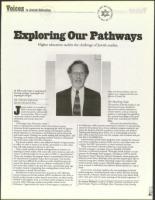
Dr. Steven Weiland is professor of higher education and director of the
Jewish Studies Program at Michigan State University in East Lansing.
9/15
2000
51