
There was a time when I just got sick of seeing
myself, this Gwyneth Paltrow person who I'm sure
everyone else is as sick of. So I decided to make fun of
myself. I see a big separation between what the world
sees me as and who I am. So I try to be me, live my
life and ignore what the tabloids write. They don't
know me, and what they write is not about me. So
why torture myself?
JN: In The Talented Mr Ripley, you played someone
who is manipulated and deceived. Has that ever
happened to you?
GP: Unfortunately, yes. But the interesting thing that
comes out of that situation is "What is there about
me that made me vulnerable to this person or this sit-
uation?" Instead of blaming the other person, I try to
take responsibility for what I did to make myself so
vulnerable. In this business you come across a lot of
people who aren't totally above board, so you learn to
trust your instincts.
JN: And has it helped?
GP: I'm basically a pretty trusting person, so it occasion-
ally gets me into trouble, but I think I have pretty good
instincts about people. Although I have been occasional-
ly wrong, it's only because I didn't fully trust myself. So
the lesson is, listen to your instincts. Whenever I've had
a funny feeling about somebody; I've told myself I was
not giving that person a chance, but it always turns out
I was right; so listen to your instincts.
JN: It would appear that the great love of your life is
your father. Has your relationship changed over the
years?
GP: Not really. After I became successful, it was my
parents and my brother who grounded me. They kept
me really centered, and they've never treated me dif-
ferently. They've never freaked because of what's hap-
pened to me. They're very decent, solid people, and
when I was growing up, my father was the most won-
derful father in the world.
He was always patient and loving, and I can
remember when he would come from work — I
was a little girl — we would build blocks together.
And when my mother was working in the theater
or on a set, he would give me a bath, wash my
hair, dry my hair.
The best story I can remember was when I was 10
years old. My mother was shooting a film in London,
and my brother and my father and I went there dur-
ing spring vacation to visit her. My father said, "OK,
Jake and mom are going to spend a special weekend
together in the country, so you and I are going to
have a special weekend — in Paris."
I had never been there before. We went all over. He
let me eat whatever I wanted — French fries and coke
for breakfast — and we had a great time. We visited
museums, and on the plane back to London he told
me, "You know why I took you to Paris, just you and
I? Because I wanted you to see Paris for the first time
with a man who will always love you no matter what."
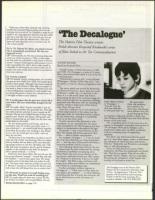
`The Decalogue'
The Detroit Film Theatre screens
Polish director Krzysztof Kieslowski's series
of films linked to the Ten Commandments.
AUDREY BECKER
Special to the Jewish News
Initially airing on Polish television in 1988
and 1989, The Decalogue is a series of 10 short
films, each thematically linked to one of the Ten
Commandments.
"[Kieslowski's] greatest gift," writes Michael
Wilmington, Chicago Tribune film critic, "was
his ability to create an illusion of spying on real-
ity.'
The series, which was written by Kieslowski
and Krzystof Piesiewicz, draws upon the world
of Warsaw's middle class. As depicted in the
films, it is a cold world, bleak and forlorn.
Dominating the film is the recurrent image of a
drab, concrete high-rise: an apartment building
populated with characters who are searching for
answers, trying to make sense of the choices
with which they are faced.
Each film is effective on its own and can be
viewed independently of the others, but the
filmmaker links the individual stories in beauti-
ful and subtle ways, making it a worthwhile
event to see the entire work.
As each successive film illustrates a com-
mandment, we are reminded that the moral
code prescribed by the Old Testament has been
subject to interpretation throughout the ages.
Kieslowski — who is better known for his
films The Double Lift of Veronique and Three
Colors
offers a further interpretation.
For example, Decalogue 1
"I am the Lord,
thy God; thou shalt have no other gods before
me" — tells the story of Krzysztof and Pawel, a
university professor and his young son.
The endearing relationship between the two
is characterized by their enthusiasm for solving
mathematical problems and playing chess.
When Pawel asks is he can go skating on the
local pond, which has frozen over, they consult
the computer to determine if the ice can hold
his weight. The film's tragic conclusion chal-
lenges us to define and redefine our understand-
ing of faith in a technological age.
Another university professor appears in
Decalogue 8
"Thou shalt not bear false wit-
ness against thy neighbor" — in which Elzbieta,
researching the fate of Jewish war survivors, sits
in on ethics lectures at the University of
Warsaw.
—
—
—
JN: Obviously it's going to be tough finding some-
one like that. Would you settle for anything less?"
GP: It's tough when you have men in your life like
my brother, my father, and my grandfather who are
Pawel (Wojciech Klata)
in "Decalogue
"l am the Lord, thy
God; thou shalt have
no other gods before me."
She approaches
Zofia, the professor,
and confronts her
about their shared past:
when Elzbieta was a lit-
tle girl during the Nazi
Occupation, Zofia had refused to shelter her.
Now Elzbieta will finally learn how little she has
known of her own story
The compelling layers of rich irony are a tes-
tament to Kieslowski's masterful construction of
The Decalogue. With sparse dialogue, and a
steady and somber pace, the films reverberate
with the unsettling sense of impending
epiphany.
Not about easy distinctions between good
and evil, these films appear, rather, to document
the ambiguity of moral decisions and human
behavior. Kieslowski and Piesiewicz continually
tease us with this ambiguity.
Given the Old Testament source of their
inspiration, the films are surprisingly not moral-
istic. They do not preach. They do not offer a
packaged solution. Rather, they act as parables,
illustrating the complexity of the human rela-
tionship to God and to moral law. ❑
The Decalogue runs at the Detroit Film
Theater for five consecutive Mondays, Sept.
18-Oct. 16, beginning at 7:30 p.m. Two
episodes will be shown at each screening.
Tickets are $6 for each screening. For a
complete schedule, call (313) 838-3237.
FATHER KNOWS BEST on page 118
2
Scanned image of the page. Keyboard directions: use + to zoom in, - to zoom out, arrow keys to pan inside the viewer.
September 15, 2000 - Image 117
- Resource type:
- Text
- Publication:
- The Detroit Jewish News, 2000-09-15
Disclaimer: Computer generated plain text may have errors. Read more about this.