
INSIDE
An Artists
Mchetnv 0 —
ffq0SUUMD:a,
Bookshelf:
.:- orever
A .Conversatit)n With
(1;w-yrie0.4..$. Paltrow
_go3wAswomm3m.aws mtKn
o,aktil,,,Kg,x.o.,-*A
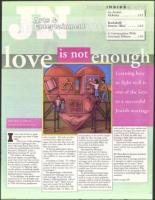
Learning how
to fight well is
one of the keys
to a successful
Jewish marriage.
Special to the Jewish News
I f you want to have a good
marriage, you need to fight
right."
This is one of the messages
from the book Fighting for Your
Jewish Marriage (Jossey-Bass; $25),
written by psychologists Joel Crohn,
Howard J. Markman, Susan L.
Blumberg and Janice R. Levine.
The authors, all possessing
advanced degrees in psychology,
assert that it isn't love that can best
predict the future of a relationship
but the ability to handle conflict.
At the heart of "fighting right,"
say the authors, is teaching couples
a style of communicating called the
Speaker/Listener Technique.
In the dialogue, the speaker corn-
municates his or her thoughts and
feelings without attacking the listen-
er. Then the listener paraphrases
what was said. The roles are then
reversed. Even when one doesn't
agree with what the other says, the
goal is to show respect for and vali-
date the partner.
"If [Jewish philosopher] Martin
Buber and [Humanistic psychologist]
Carl Rogers were to have a dialogue,
this would be it," says co-author Joel
Crohn.
According to Crohn, "To validate
your partner means that you under-
stand how it makes sense for your
partner to feel a certain way, even if
you disagree."
The psychologist understands
firsthand the challenges that come
with marriage. He and his wife,
Mindy, a child psychiatrist, will cel-
ebrate their "chai" (18th) anniver-
sary next month. In San Rafael,
Calif, where the Crohns live with
their children, Raft 15; Shira, 12;
and Jonathan, 8, he teaches couples
to fight for their marriage using
concrete exercises and tools based
on an approach called PREP, the
Prevention and Relationship
Enhancement Program.
Developed by Howard J.
Markman and Scott M. Stanley,
who have conducted 20 years of
extensive empirical research at the
University of Denver on what makes
marriages work and what destroys
them, PREP is not therapy but an
educational approach that teaches
couples how to have strong and
happy marriages.
Its skill-building method helps
couples communicate effectively,
work as a team to solve problems,
manage conflicts without damaging
closeness and preserve and enhance
love, commitment and friendship.
Couples who have learned to deal
with conflict have more resilient and
satisfying marriages than those who
avoid facing their differences, says
Crohn. It is clear, he adds, that
learning to fight right can profound-
ly benefit a marriage.
The Jewish. News recently spoke
with Dr. Crohn about his book, his
career and his own successful rela-
tionship.
JN: How did you become involved
in marital therapy?
JC: I have been a marriage and fami-
ly therapist as well as a practicing
psychologist for 22 years. I have
always seen people as part of some-
thing larger than themselves. Why
be Jewish if we are not going to feel
connected to somethinab bigger
than
b
o urselves?
LOVE on page 108
Scanned image of the page. Keyboard directions: use + to zoom in, - to zoom out, arrow keys to pan inside the viewer.
September 15, 2000 - Image 105
- Resource type:
- Text
- Publication:
- The Detroit Jewish News, 2000-09-15
Disclaimer: Computer generated plain text may have errors. Read more about this.