

Women Of The Book
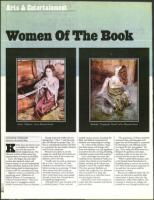
Sarah, "Dtliance," oil on Masonite board.
SUZANNE CHESSLER
Special to the Jewish News
ic
irsten Coco has found a way
to combine her artistic tal-
ents with her quest for
Jewish enlightenment. The
Houston mother of three paints her
representations of women in the Bible.
Coco, who began this series after
another that depicted today's well-
known women, is not just looking back
at Ruth, Batsheba, Sarah and the others.
She's looking ahead by depicting them
as role models for contemporary living.
Eighteen works are completed in her
continuing series, "Reflections of
Biblical Women: A Contemporary
Vision of Ancient Stories." They have
been shown at synagogues and the
Jewish Community Center in Houston.
9/8
2000
74
Temple Israel will exhibit the ren-
derings Sept. 7-Nov. 7, and the artist
also will discuss her project Sept. 18,
first at a sisterhood luncheon and later
at a reception for the temple's museum
and fine arts committee.
Because Coco plans to use the
images in a book that will include nar-
ratives about each of the women she
admires, none is for sale.
"I really want to reach as many peo-
ple as I can," says Coco, 42, who
worked as an architect for 15 years
before moving on to painting. "I think
these women and their stories are
extremely important, and I decided
that I could reach many more people
through a book than through shows
and speaking engagements.
"Although this is not intended to be
a scholarly project, I have read and
Batsbeba, "Longing f r David," oil on Masonite board.
studied various sources, including the
Bible and biblical interpretations,
Midrash and archaeological writings.
'As a result of this research, I hope
that these women will emerge with
form and substance, not only significant
as ancestors but also as living, breathing,
individual women much like ourselves."
Coco, who began the series after
studying Torah, champions Vashti as a
woman who refused to put herself on
display, standing up for values even
though it meant she could be killed.
The artist portrays Batsheba as a
mother who taught her son, Solomon,
what he needed to be king. She
depicts Sarah as an individual intent
on retaining her identity.
Ultimately, Coco wants women to
realize that their ancestors had choices
and so do they.
"The experiences of these matriarchs
transcend time, showing again and
again how all of humanity is connected
by shared pain and suffering and by
our search for love and passion," she
says. "Even today, the Bible serves as a
blueprint for guidance and solace,
teaching us that we are part of a con-
tinuum and that we are not alone.
"When I speak before groups, such
as the Temple Israel Sisterhood, I'm
hopefully going to convey my journey,
how these stories became important to
me and how the stories could be
important to them."
Because of a difficult family life, the
artist was allowed to spend her high
school years in Israel, where she was
adopted as a child of her kibbutz. She
returned to America for college and
worked her way through bachelor and