
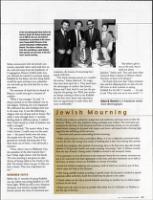

In the last photograph taken before Hy
Safran's death, the Safran family gath-
ers in 1982 for his son Jim Safran's
installation as president of the Junior
(now Young Adult) Division of the
Jewish Federation of Metropolitan
Detroit. The Safran children, Jim,
Fred, Ken and Sharon, stand behind
their parents, Hy and Leah, at the divi-
sion's annual meeting.
Safran reconnected with the Jewish com-
munity, especially when work took him on
the road and away from the familiarity of
Congregation Shaarey Zedek's daily min-
yan. Because he wanted to continue saying
Kaddish for his father, the first thing Safran
would do upon arriving in an unfamiliar
city was look up the local shul for its min-
yan times.
The sameness of ritual that he found sti-
fling as a youth now gave a measure of
comfort.
"When I was younger," he said, "it
always seemed to me that Judaism was an
old religion. Nothing new ever happened.
We celebrated the same holidays each year
in the same way. It was like following a
religion that was all past and no future. But
while I went through those 11 months,
finding shuls in different places, I realized
what I had viewed as a fault of Judaism was
really a strength."
He continued, No matter where I was,
I had a home. I could count on the same-
ness — the prayer books were the same,
the people were the same. They always
greeted me warmly, knowing that if I'm
there from out of town, I was obviously a
mourner.
"Once, when I was in Oklahoma City,
the president of the shul insisted that I
have Friday night dinner with his family.
The next morning I was given an aliya
(honor of being called to the Torah] at the
shul. No matter where you go, it's like you
have a home. That was a big lesson for
me.
RENEWED FAITH
Before the 11 months of saying Kaddish
was up, Safran was seeing Judaism in a dif-
ferent light. While he still is not a frequent
shul-goer, and watches younger brother
Jimmy assume the reins of communal par-
ticipation, the lessons of mourning have
stayed with him.
"The whole minyan process is a wonder-
ful system," Safran observed. Its tragic
that most Jews don't do it. They don't have
the advantages of comfort that Jimmy,
Kenny and I had. And it's not just the get-
ting but the giving, too. With new mourn-
ers always coming to shul to say Kaddish
for the first time, those with experience
have an opportunity to make them feel
more comfortable.
"My father's gift to
me, in the end, was to
teach me about
Judaism," Safran said. "You can't learn what
I learned about minyan in Hebrew school.
You have to learn it by doing it."
He firmly feels now that when someone
dies and his offspring don't sit shiva for the
full term or don't commit to saying
Kaddish for the full 11 months . . . it's real-
ly sad. They miss out on so very much."
Debra B. Darvick is a freelance writer
from Birmingham.
n i ng
All life-cycle events are ordered by unique laws and traditions, and none more so than the
final one. When a Jew dies, Judaism's caring is perhaps most evident. The meticulous pro-
scriptions for the body of the deceased and those in mourning, focuses on two principles:
kavod hamet, treating the deceased with respect and honor, and kavod hechai, showing high
regard for the well-being of the survivors.
Some laws and customs surrounding Jewish mourning:
• While many mourners wear a torn black ribbon, it is not a religiously sanctioned substi-
tute for the kria, the tearing of an article of clothing that is then worn during shiva period.
• Jewish law recognizes three periods of mourning: shiva is the first seven days after burial;
shloshim is 30 days after burial; and avelut, meaning "mourning," lasts 12 Hebrew months
from the day of burial. During avelut, Kaddish is recited in the mourners' home.
• It is customary to cover all mirrors in the mourners' home for two reasons: mourners are
not to be concerned with their appearance at this time, and since minyanim occur daily at
the home, as always, mirrors are forbidden in a house of worship.
• Jewish law forbids embalming and cremation, both of which are viewed as acts of dese-
cration upon the body of the deceased.
• After being carefully washed according to specific ritual, the deceased is clothed in special
garments called tachrichim. Earth from Israel may be placed in the casket.
• Closed caskets are the rule at Jewish funerals, denoting yet another way in which respect
is shown for the dead.
• Burial must take place as soon as possible after death, but it is forbidden on Shabbat or
the first day of festivals.
n • sourcebook 2000 •
23