

ine art photographer Monte
Nagler shares his Farmington
home office with Ansel Adams, •
Irving Penn and Edward Curtis.
Black and white images by these legendary
photographers grace the walls and vie for
attention with Nagler's own dramatic shot of
Bond Falls in Bruce Crossing, Mich. Penn's
N Guinea's
extraordinary photograph of Nev
Okapa Warriors is perhaps the most valuable
of Nagler's extensive photo collection.
Nagler's home has the feel of an art
gallery, one in which you wander from room
to room, marveling at the diversity and origi-
nality of the images that line the walls.
"Living with all of these photographs keeps
my creative juices flowing," says Nagler. "They keep me
inspired and excited."
Consider the family room collection. Tony Spina's
Winston Churchill and Admiral Nimitz photograph captures
the eye, along with recognizable shots of Garbo, George
Bernard Shaw, Arthur Rubinstein, Stravinsky, Babe Ruth
and Martin Luther King. Also in this room, find Nagler's
triptych of Monument Valley. "I was standing in Utah and
loOking through the camera at Arizona," says Nagler of one
of his favorite. places in the world to photograph.
Nagler's Michigan cowboy series shares
prominent space with his sweeping photo-
graphs of the sand dunes in Death Valley, the
f\Ioeraki boulders in New Zealand and a fog-
shrouded lotus pavilion in Seoul, Korea.
Many of the images in Nagler's collection
are "moonrises," a term used to identify a
photographer's most famous picture. Alfred
Steglitz's "The Steerage," and Dorothea
Lang's "The Migrant Mother" are those
artists' moonrise photographs. And Nagler
owns both of them.
Monte Nagler stumbled Onto photography
at age 39, some 20 years ago, when he met
Ansel Adams. At the time, he was running
two Midas muffler shops, having abandoned
his engineering career at Ford Motor Co.
"Muffler shops — how exhausting!" he says now, with -a
wink. After intensive study with Adams, Nagler realized
that making photographs "was a way to experience beauty
instead of just looking at it."
Nagler has since won numerous awards and is a noted
writer, lecturer and teacher of photography. He is one of 40
members of the esteemed Camera Craftsmen of America.
PHOTOGRAPHY BY SANTA FABIO
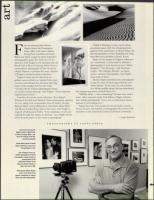
Clockwise from top left:
Nagler's photo of Bond Falls,
in Bruce Crossing, Mich., cap-
tures the majesty of the fog-
shrouded waterfall.
Death Valley Dunes in Death
Valley California, comes alive
through Nagler's lens.
One of Nagler's most col-
lectible photographs is Alfred
Eisenstaedt's image of dancers
photographed at the
Balanchine School of the
American Ballet Theater in
New York City in 1936.
Photographer Monte Nagler
poses in his family room
against a backdrop of original
black and white photographs.
—Linda Bachmck