

Reprinted with permission of the
Jewish Historical Society
Now You Know
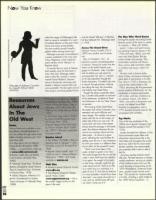
Silhouette of Solomon Carvalho
by Augustin Edouart (date
unknown).
Rachel Cables Story by Rc
Calof (Indiana University Press,
1995)
• I Married Wyatt Earp: The Recol-
lections ofjosephine Sarah Marcus
Earp.by Josephine Earp. (University
of Arizona Press, 1976)
• Dakota Diaspora: Memoirs of a
Jewish Homesteader by Sophie
Trupin (University of Nebraska Press,
.
1988)
JN
8/25
2000
94
was the famed "little Jew" at Beecher,
within the range of [Shlesinger's] rifle
but few believed him. Shlesinger died
had no cause to complain of a want
in 1928.
of marked attention on the part of that
brave and active young Israelite ...
Across The Grand River
He most worthily proved himself a
Solomon Nunes Carvalho (1815-
gallant soldier among brave men."
1897) was another man of adven-
Shlesinger was even immortalized in
ture.
a poem, published in the Army and
Born in Charleston, N.C., he
Navy Magazine, which makes fre-
I
became
a painter and photographer
quent mention of the "little Jew" at
of renown. Among his works was the
Beecher Island.
interior
of the Kahal Kadosh syna-
1
If it sounds like too much to believe,
gogue
in Charleston. Later, Carvalho
that% exactly what the folks back in
took his talents out west when he
New York said. Shlesinger settled
accompanied Col. John C. Fremont
there in later life, married a woman
on his last expedition through the
named Fannie Flesheim, became
Rocky Mountains. Carvalho's job was
active in the Jewish community and
to record, through pictures, what he
started a tobacco business (this one
1
saw along the way: the mountains
was successful). He also spent a lot of
and Indians and Great Plains.
time trying to convince people that he
Though the photos eventually were
lost, Carvalho did publish an account
of his adventures, Incidents of Travel
I and Adventure in the Far West. Here's
an excerpt:
"The Crossing of the Grand River,
the eastern fork of the Colorado, was
attended with much difficulty and
more danger. The weather was exces-
s sively cold, the ice on the margin of
I either side of the river was over 18
inches thick; the force of the stream
I always kept the passage in the centre
open; the distance between the ice,
was at our crossing, about two hun-
dred yards... To arrive at a given
point, affording the most facilities for
etting upon the ice, it was necessary
to swim your horse in a different direc-
tion to allow for the powerful current.
"I think I must have been in the
I water, at least a quarter of an hour.
The awful plunge from the ice into the
Publications, 1989) – both books
I water, I never shall have the ambition
available at OMOZOILCOM
to try again; the weight of my body
I on the horse, naturally made him go
Web Sites
I under head and all; I held on as fast
• American Jewish Historical Socie
as a cabin boy to a main-stay in a
www.ajhs.org
gale of wind. If I had lost my balance
• The Magnes Museum's Western
I
it is most probable I should have been
Jewish History Center:
drowned. I was nearly drowned as it
www.magnesmuseum.org — this is
was, and my clothes froze stiff upon
the world's largest archive on the
I me when I came out of it."
Jews in the west
I The Men Who Hired Boone
1 Among the papers recounting Daniel
I Boone's survey of the west is a series
I of contracts — filled with Yiddish.
Jacob I. Cohen and Isaiah Isaacs,
two leading American figures in the
1700s and early 1800s, were the
1 ones who hired Boone, the leg-
endary hunter and pioneer. Their •
handwritten contracts with Boone
I show various side comments written
I in Cohen's and Isaacs' native Yid-
dish.
Not too much is known today
about Cohen, but Isaacs achieved a
1 great deal of prominence in his life-
' time. Born in 1 747 in Germany, he
I came to the United States in the
1760s, becoming the first permanent
1 Jewish resident of Richmond, Va. He
I established a business partnership
with Cohen, and also worked as a
tax assessor. Isaacs, who died in
11806, was active in the Jewish corn-
' munity. He helped found Beth
I Shalome Congregation, and in
1791 donated property used for the
synagogue's first cemetery.
Top Marks
One of the top marksmen of the
1800s was a Jewish immigrant from
Poland named Philo Jacoby (1837-
1922).
Jacoby founded the Hebrew, a San
Francisco-based paper filled with
information about Jewish life in the
Old West and throughout the world.
But if you didn't like his views (and
Jacoby certainly was opinionated),
you probably didn't want to take it
too far.
As a boy, Jacoby joined a local
rifle club. He later became a champi-
onship marksman, serving as captain
of the California team that won the
world shooting championship at the
1876 Philadelphia Centennial Expo-
sition. Jacoby would receive more
1 than 100 awards for marksmanship
in his life, including a gold medal at
1 the 1890 Vienna Exposition.
I
❑