

IN THE
Crystal Ball
GEORGE DILA
Special to the Jewish News
D
avid Littmann, who
this month celebrates
his 30th anniver-
sary as an econo-
mist with the same finan-
cial organization, is a man
who finds meaning in
looking to the future, as
well as in looking
towards the past.
He looks forward
for a living, as senior
vice president and
chief economist for
Comerica Bank. He
looks backward for
inspiration, to his fore-
bears who set the exam-
ple of hard work and
achievement that he strives
to follow.
Littmann's great-grandfa-
ther Max, looking for a better
future, immigrated to America in
1867 when he was 21 years old.
After a hitch in the Army fighting the
Sioux in Wyoming, Max settled in St.
Louis.
_
"For a while my great-grandfather was a boot- •
black," Littmann says. "He used to polish the shoes of two
businessmen, a Mr. Nixdorff and a Mr. Krein, who owned a corn-
pany that made wagon hitches. They saw something special in
him, and hired him."
The two businessmen must have been excellent judges of char-
acter. Max rose to the top, eventually becoming the CEO of
Nixdorff-Krein Industries. "The company kept up with the
times," Littmann says, "changing its product line from wagon
hitches to tire chains."
And there are more family success stories. Littmann's grandfa-
ther became a vice president of Nixdorff-Krein, his father became
a respected physician, his uncle became a well-known architect,
with the design of Detroit's Cobo Hall and the Cape Canaveral
launch pads in Florida to his credit. It's a heritage that Littmann
looks back on with obvious pride.
As chief economist for Comerica, Littmann looks toward the
future, predicting business trends, forecasting financial activities
and interest rates, tracking the local,
regional and national economies, and
giving his bank and its customers
the economic tools to plan for
their,future.
The Wall Street Journal has
called him one of the most
accurate economic forecast-
ers in America, and the
Federal Reserve Bank of
Chicago gave him its
Best Overall Forecast
Award for 1998.
David
Littmann grew up
Littinann;-
in St. Louis but came
career has been
a bit east for his high-
as showy as his
er education. He got a
violets.
bachelor's degree from
Antioch College in
Ohio, including a year
at the London School
of Economics, and two
master's degrees, both in
economics — one from
the Massachusetts Institute
of Technology and one from
the University of Michigan.
It was at U-M that he met Esther
Gorny, a native of Stettin, Germany,
who had come to the United States as a
child in 1947. They married in 1967 and
recently celebrated their 33rd wedding anniversary.
Also in 1967, his formal education completed, Littmann
took a job as a systems analyst with the Burroughs Corporation in
Detroit.
"I was fascinated by the new technology," Littmann says. "I
wanted to know about computers. Burroughs let its systems ana-
lysts do everything — design the systems, write the programs. It
was a great education."
In 1970, Littmann took a job with Manufacturers Bank as an
assistant economist in the corporate planning department. Within
three years he was made chief economist, and he continued 'in that
role when Manufacturers merged with Comerica in 1592. In
1998, he was promoted to senior vice president.
Why do banks need economists? According to Littmann, the
two primary reasons are a-bank's profit picture and as a service to
business customers.
"Forecasting the movement of interest rates has the biggest pay-
back for the bank," he says. "It guides our policy for profitability"
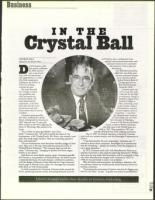
David Littmann marks three decades in business forecasting.
8/25
2000