

Affirmative Action Affirmed
factor in the medical school admissions process but
cannot be the deciding factor.
The Anti-Defamation League, the American
Jewish Committee and the American Jewish
Congress all filed briefs in support of Alan Bakke,
the white medical student applicant who challenged
the racial quota system.
Black-Jewish tensions resurface in a flap over Lieberman stance.
SHARON SAMBER
Jewish Telegraphic Agency
Jewish Views Differ
Today, affirmative action remains a difficult issue
within the Jewish community.
The Orthodox Union, for example, is more sym-
pathetic to a class-based model of affirmative action
than a race-based one, said Nathan Diament, direc-
tor of the OU's Institute for Public Affairs.
The group eschews quotas and supports assistance
to people based on individual need, rather than by
membership in a particular racial and ethnic group.
While there are nuanced differences among
Jewish organizations, the consensus appears to sup-
port "properly structured" affirmative-action poli-
cies, according to a two-year study on the issue by
the Jewish Council for Public Affairs, an umbrella
group of Jewish organizations.
The study found a range of opinions in the
Jewish community on appropriate affirmative-action
policies, including those that question the value of
any such policies. But the majority of Jews, accord-
ing to the JCPA study, support "policies or programs
that consider race as one among many relevant fac-
tors, that accept or reward only individuals judged
to be qualified, and that do not include quotas."
For his part, Lieberman is receiving support from
prominent black leaders and organizations. Civil-
rights leader Jesse Jackson took the opportunity to
turn the issue around as he told a cheering crowd at
the convention that "Gore ended the quota of zero
of Jewish Americans on the national ticket last week.
This was a bold act of affirmative action."
Perhaps trying to halt any further damage, veter-
an civil-rights leader Rep. John Lewis (D-Ga.) said
in his prime-time convention speech, "We need a
man like Joe Lieberman to walk with us."
In the National Association for the Advancement
of Colored People's Legislative Report Card on the
106th Congress, Lieberman received 100 percent for
his voting record on civil-rights issues.
Julian Bond, chairman of the NAACP's board of
AFFIRMATIVE ACTION on page 27
S
Washington
en. Joseph Lieberman's attempts last week
to allay the concerns of some black leaders
about his position on affirmative action
showed political smarts — but it also
showed that the old tensions die hard.
Despite a general sense that ties between Jews and
blacks have improved in recent years, the Democratic
vice presidential candidate's emergence into the pub-
lic spotlight has revived issues of contention — and
revived concern about black antisemitism.
Lieberman had to clarify his position on affirma-
tive action to the Democratic National Committee's
black caucus as soon as he arrived in Los Angeles for
the convention. "I have supported affirmative action,
I do support affirmative action and I will support
affirmative action," he told the group.
And in his acceptance speech to the convention
on Aug. 14, Lieberman said he favored President Bill
Clinton's "mend it, don't end it" approach to affir-
mative action.
U.S. Rep. Maxine Waters (D-Calif), who led the
fight to force Lieberman to explain his position,
seemed appeased. The outspoken congresswoman said
she felt a lot better after the issue had been clarified.
History Of Concern
Lieberman and other Democratic officials also tout-
ed the senator's long record of support for civil
rights. He traveled to Mississippi in the 1960s to
register black voters. In the Senate, he voted to con-
tinue affirmative-action programs in 1995, and three
years later helped stop the elimination of a federal
program that enabled women and minorities to win
highway construction contracts.
While he did indicate his support for California's
Proposition 209, a 1996 failed ballot initiative that
would have abolished state-funded affirmative-action
Role Model?
Educators hope an
elected Lieberman
will spur Jewish
interest in Judaism.
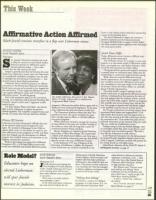
Sen. Joseph Lieberman, left, and U.S. Rep. Maxine
Waters, D-Calif, embrace after he addressed the
Congressional Black Caucus.
programs, Lieberman has said he did not agree with its
details and never endorsed the legislation. At the same
time, Lieberman has said racial quotas trouble him.
The Democratic platform makes clear that Vice
president Al Gore, the party's candidate for presi-
dent, strongly opposes efforts to roll back affirma-
tive-action programs.
While Lieberman seemed to assuage the concerns
of many blacks in the party, the incident brought to
the surface an issue that has long been a point of
contention between blacks and Jews.
Murray Friedman, an American Jewish historian
and author of What Went Wrong: The Creation and
Collapse of the Black-Jewish Alliance, said there was a
feeling in the black community years ago that Jewish
agencies stood in the way of affirmative action.
In the landmark 1977 case of Regents of the
University of California vs. Bakke, the Supreme
Court found that race could be considered as one
JULIE WIENER
Jewish Telegraphic Agency
Hempstead, NY
ewish educators are hoping that
Vice President Al Gore's selection
of Sen. Joseph Lieberman (D-Conn.)
as his running mate will do more
than make Judaism - more acceptable
to non-Jews.
They want it to make Judaism
more palatable to Jews.
At the 25th anniversary conference
last week of the Coalition for the
J
Advancement of Jewish Education,
several religious school principals and
teachers said they hope Lieberman
will become a role model for their stu-
dents. They point out that Lieberman
is an American Jew who has managed
to balance religious commitment with
success in the secular world.
"Oohing And Ahhing
-
"
Eva Eliason, a teacher in a Reform
synagogue in Cedar Grove, N.J., ini-
tially expressed skepticism when
asked whether Lieberman's selection
represents a milestone at all — what
with other Jews, like Federal Reserve
Chairman Alan Greenspan, already
in high echelons of power.
But, Eliason said, "because every-
one's oohing and ahhing" about
Lieberman and his [Orthodox] reli-
gious observance, "maybe people will
think about keeping Shabbat."
It will be -almost like a fashion,"
she added.
Stacy Garnick, education director
ROLE MODEL on page 27
8/25
2000
25