
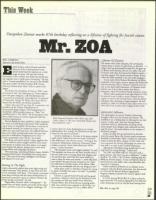

Outspoken Zionist marks 87th birthday reflecting on a lifetime of fighting for Jewish causes.
BILL CARROLL
Special to the Jewish News
Mr. Z0 11,
Lifetime Of Zionism
E
zekiel Leikin, ardent Zionist and keen
observer of the world political scene,
doesn't hold back his opinion on a wide
range of topics. He says the Zionist
movement is the "cement that holds the Jewish peo-
ple together, but it needs some revamping." He sees
only a "remote possibility" for success in the Middle
East peace talks. He feels President Bill Clinton
wants to achieve peace there "only to preserve his
legacy."
He thinks Vice President Al Gore is "OK," rates
Connecticut Sen. Joe Lieberman as "a fine religious
Jew with great integrity," calls Pat Buchanan an
"out-and-out antisemite" and really has "no opinion"
of Texas Gov. George W. Bush, other than that he
doesn't like his father, the former president.
Leikin, who turns 87 on Aug. 25, is executive vice
president of the Zionist Organization of
America/Michigan Region, with headquarters in
Southfield. Affectionately known as "Zeke," his
unofficial title is "Mr. ZOA," for having spent more
than a half-century in various capacities with the
national organization.
Slowed slightly by heart problems, Leikin expressed
his views on world leaders and issues while recuperat-
ing at home in Southfield. He has been in and out of
the hospital recently, but expects to return to his
office on a part-time basis soon. He suffered brief car-
diac arrest while visiting Israel earlier this year, and
now has a defibrillator implanted in his chest —
"that's a pacemaker with a Ph.D.," he mused.
Still sharp and quick-witted, Leikin regaled a few
visitors with his astute insights and life story, laced
with pearls of wisdom and clean jokes, in an apart-
ment lined with photos, plaques and a foot-thick
binder filled with clippings and letters.
"He's amazing," proclaimed Ruben Isaacs, Leikin's
longtime friend and a Southfield advertising execu-
tive. "He's one of the most intelligent and remark-
able figures I've ever met."
Reining In The Rig ht
Leikin reluctantly admits that some right-wing and
radical elements "find shelter" in the ZOA, but he's
not in sympathy with them. "The Zionist movement
must keep evolving with the latest developments in
Israel and continue to serve as a liaison between the
Jewish people and Israel," he said.
"Regrettably, Zionism often is denigrated — by
people who are both outside and inside of the move-
ment, and that is one of our biggest challenges. Of
No matter what Leikin discusses, the conversation
always seems to return, in some form, to Zionism — a
subject that has dominated his adult life. He grew up
in Russia and Lithuania, the son of a rabbi, who met
his future wife when he became her Hebrew teacher —
and they eloped. The family moved to Kazan, Russia,
where his father presided at the city's only synagogue.
In the midst of the Russian Revolution, his father
preached a Yom Kippur sermon against the Bolsheviks
and was forced to flee to Moscow, where he was hid-
den in the chief rabbi's basement. A Christian maid
hid the rest of the Leikins before they fled to
Lithuania, where his mother's family owned an estate.
When Leikin graduated from high school in 1932,
he wanted to go to Italy to study. Instead, he was
urged to come to the United States, where his father
had gone after obtaining a forged passport. He had
settled as a rabbi in Cleveland, but Leikin went on to
New York City to enter City College of New York.
Jabotinsky's Influence
ZOA National President Mort Klein says Zeke
Leikin, above, is "the most committed Zionist any-
one would ever meet."
course, there are some disagreements on certain
philosophies, but, mainly, we [Zionists] are all com-
mitted to the survival of Israel."
Another challenge to Zionism is the peace process
itself, which Leikin fears has too many "irreconcil-
able differences" that thwart success. "As long as the
antisemite [Palestinian Authority Chairman] Yasser
Arafat is around, I don't think there ever will be
peace," Leikin lamented.
"The Jerusalem issue is the biggest problem," he said.
"We shouldn't just fritter the city away. Another issue is
that the Arabs want to swamp Israel with refugees, and
we can't have that. And I feel that many Israelis just
want to keep the status quo anyway — some who don't
care whether the peace process succeeds or not. There
are millionaires in Israel's version of the Silicon Valley
who are very comfortable with the way things are now"
Leikin gives credit to President Clinton for trying
to achieve Middle East peace, but feels "it probably
will be to no avail.
"Clinton is a good friend of Israel and has good
intentions, which are driven by his fascination with
the memory of [the late Israeli Prime Minister]
Yitzhak Rabin. But [Clinton's] just coasting politi-
cally now, and his main purpose in all of this, is to
try to preserve his legacy. It's not a selfless effort."
The philosophy of activist Vladimir Jabotinsky
brought Leikin into the Zionist movement. "He
instilled in me a feeling that we belonged to an elite
nation," Leikin said, "and that feeling always
remained with me. Jabotinsky's teachings saved
many people from despair, and awakened our feel-
ings for Israel. I fervently believe in the mission of
the Jewish people."
Leikin actually first got interested in Zionism
when he joined Betar, the Zionist youth movement
founded by Jabotinsky, while a student.. in Lithuania.
Leikin headed the Betar chapter in New York and
even espoused the Zionist philosophy on street cor-
ners and at a camp in the Catskill Mountains.
"Jabotinsky electrified young people and we car-
ried forth his strong feelings," Leikin said.
"In 1936, my father told me: 'If you're such a
great Zionist, why don't you go to Palestine,"' Leikin
recalled. "So I did — for 10 years. Making aliya ful-
filled my Zionist dream." It was in Palestine that he
met his future wife, Bella, who, coincidentally, also
came from Lithuania.
Leikin worked in Palestine as an assistant citrus
inspector with the British authorities, but also served
in a form of the famous defense organization
Hagana, helping to protect the country against Arab
marauders.
In 1943, during World War II, Leikin received a
letter from the U.S. consul urging him, his wife and
other Americans to be on the last boat leaving from
-
MR. ZOA on page 18
AA
8/25
2000
17