

Weill considered Der Neue Orpheus, a cantata
based on a poem by Iwan Goll, to be a turning
point in his career because of its wide stylistic
range. His use of dance idioms and his pursuit of
collaborations with contemporary playwrights had
become his essential strategies to reform the musi-
cal stage.
A commission from the Baden-Baden Music
Festival in 1927 led to the creation Mahagonny and
his first collaboration with Bertolt Brecht, the
German Marxist playwright and poet. The two
went on to do . contemporary operas and works for
the commercial theater, including Die
Dreigroschenoper ("The Threepenny Opera") and
Happy End.
Weill's interest in political theater teamed him
with Caspar Neher for the epic opera Die
Burgschaft and Georg Kaiser for the play with
music Der Silbersee. The latter, the target of Nazi
protests in 1933, encouraged Weill to leave
Germany. He and his wife, singer/dancer Lotte
Lenya, got out of the country on the day the
Reichstag was destroyed by fire.
Under Hitler, Weill's music was banned, and the
Gestapo raided the offices of his publisher and
destroyed all copies of his scores as well as the
plates from which more copies might have been
printed.
Meanwhile, after his escape to France, Weill
completed his Second Symphony and went on to do
a ballet and cabaret songs.
With his move to the United States in 1935, the
composer looked for new collaborators. He worked
with playwright Paul Green, whom he met through
the Group Theatre of New York, a socialist organi-
zation, on the musical Johnny Johnson, and thought
he would continue in the vein of the kind of politi-
cal and social musical theater he had created in
Berlin.
But in the America of Franklin Roosevelt, he
relaxed some, completing scores for films such as
You and Me and establishing himself as an original
voice in American musical theater. He collaborated
with Maxwell Anderson for Knickerbocker Holiday,
Moss Hart and Ira Gershwin for Lady in the Dark,
S.J. Perelman and Ogden Nash for One Touch of
Venus and Alan Jay Lerner for Love Lift.
"One of the things Weill always looked for [in
collaborators] is people who may not have worked
in musical theater before," says David Farneth,
director of the Weill-Lenya Research Center at the
Kurt Weill Foundation for Music.
"For him, it was important to have a person of
high literary level to work with. He looked for peo-
ple who had made reputations on their own as
playwrights, poets or novelists. I think this is why
he got such a wide range."
During the 1940s, Weill contributed extensively
to the American war effort as well as a series of
Jewish and Zionist pageants: He remarried Lotte
Lenya, whom he met in 1920s Germany, where she
sang the role of Jessie in Mahagonny. They had
divorced after leaving Germany.
"Weill was the third of four children, and his
parents and family left Germany before they had
Music on page 80
Brunch With Well
A Sunday performance at the DIA will recall
the genius of Kurt Weill.
a.rnela Jordan Schiffer has
been reading lots of love
letters lately, but they have
not made any personal impact.
Instead, they are affecting her pro-
fessional activities as she prepares
a concert celebrating the work of
Jewish composer Kurt Weill.
In the year when perfortners
around the world are marking
• centenary of Weill's birth,
ute comes Sunday,
the Detroit Institute
runch With Bach
anied by
of Michigan
er-orchestrator Gerald
esoprano will recall
e composer's
p
and it's very dramatic. Another is
a really fun one from Love Life;
it's called "Mr. Right" and is
about a woman's ideal man."
Although Weill's songs have
been written in German, French
and English, Schiffer tries to
present them all in English and
intersperse the foreign languages
when the lyrics are repetitive.
"Kurt Weill had wonderful
lyricists for his shows," Schiffer
says. 'He collaborated with
d
n reading the letters
eilt and his
vif e,.Lenya, 7, explains
Sch.i e , Where career currently
plays ..Out: wit '20th-century
musical performances, cantorial
assignments and teaching at
Oakland University. "The letters
give me lots of information
about their lives and their rela-
tionship.
'With the exception of two
songs, everything is in chrono-
logical order. We want to high-
light the different periods in his
life from his beginnings in
Germa.ny with The Threepenny
Opera, then a show he did in
Paris and finally his top musicals
in the United States.
"We only have an hour so we
can t cover everything. We may
not be able to get in some of the
movies that he did."
Schiffer, who moved to
Michigan from Baltimore three
ears ago, did a DIA cabaret
ram in October, when she
four Weill songs. Based
ottnance, she was
e centenary trib
'
:
vOntes Weill
in his show Happy
n th e soprano explains. "It's
about a yourii4bman hooked up
with a` had character who travels,
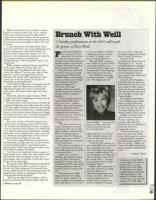
Pamela Schiffer: 7 want the DM
audience to know what Neill
wrote and hear the material
that isn't heard often.
Ogden Nash for One ToUch of
Venus, Maxwell Anderson for
Lost in the Stars and Alan Jay
Lerner for Love
"I want the DIA audience to
know what Weill wrote and hear
the material that isn't heard
often. I also want to give people
a broader understanding of his
life, telling about each show and
what was going on in his life at
the time he wrote it. I've been
doing research, which includes
reading the letters."
Schiffer, who always seems to
have been interested in singing,
spent her early years in
Cleveland and graduated from
Indiana University. After teach-
ing junior high band and
orchestra in Los Angeles, she
moved to Baltimore and built
Life.
her career over 17 years, per-
forming throughout the United
States, Canada and Europe.
Still part of the
Contemporary Music Forum in
Washington, D. C., she has
established herself in Michigan
through engagements for the
Plymouth Community Arts
Council, Ferndale Concert
Series and the Great Lakes Lyric
Opera of Detroit.
Awarded a Solo Recitalists
Fellowship from the National
Endowment for the Arts to per-
form recitals of 20th century
music, she has premiered more
than 30 new works and record-
ed on the CRI, Centaur and
Capstone labels.
She studied at the Hebrew
Union College in Los Angeles
before moving to Baltimore,
and has functioned as a cantor
for more than 25 years. She is
currently a visiting cantor at
Shaarey Zedek in East Lansing.
Schiffer, a member of the
National Council of Jewish
Women, worked on the
women's seder offered by
Federation last year and has per-
formed for the Jewish
Community Center.
"In the last four years, I've
done more and more theater
music, and my goal is to contin-
ue doing innovative program-
ming that brings audiences in to
hear new things," Schiffer says.
"I never do traditional program-
ming. I never do anything tradi-
tional."
❑
— Suzanne Chessler
1)tut41
.12: -:
.
8/11
2000
79