

ELIZABETH APPLEBAUM
Special to the Jewish News
0
n stage, she's got her dark-
brown hair piled high as the
mountain of lies a cheatin'
husband will tell, and she
wears a long, silky skirt and a black
shirt that's fine and feisty.
She sings, "It ain't Mother's Day, it
ain't Father's Day, it's just a rainy day
with a cool breeze."
Off stage, she's got a white tichel
covering the hair that hangs to her
waist, three children she's home
schooling, and plenty of organic
strawberries and blueberries in the
freezer. Add them to ice, water,
banana and a bit of sugar and there
you've got it: a frothy, fresh drink with
tiny bits of fruit floating about, cold
enough to leave a sweet sting.
She says, "I am grateful to HaShem
for everything He has done for me."
Rachel Pashman is nothing if not
determined. And these days, her goal
is clear. This Oak Park resident —
who lived in foster homes from the
time she was, 5, married at 16 and
divorced a few years later, adopted her
sister's child, fought off Arabs while
living in Israel's administered territo-
ries, and helped her second husband
survive two brain surgeries — wants
to make it as a country singer.
"I believe I can do anything I set
my mind to do and try as hard as I
can so long as I'm good and do the
things HaShem would want me to do.
No," she adds. "I don't have any self-
doubt, and I'm not afraid."
Her life sounds just like one of
those country ballads Patsy Cline
might have sung: Love gone wrong,
hard times — and plenty of hope.
That story begins with her father,
David, and her mother, Mary.
Mary was three-quarters Creek
Indian and Jewish, with family roots
originally in England, Pashman says.
Her father is one-quarter Cherokee
and also traces his family's origins to
England.
Their first daughter, Rachel, was
born at the Alexandria Military
Hospital in Virginia. Two years later a
second girl, Gail, came along.
The family moved to Georgia,
where Rachel spent most of her
youngest years. She remembers good
times, like making candy with her
mother, and being happy.
When Rachel was 5, however, her
parents divorced. She says the prob-
lems were the result of their "irrespon-
sibility."
The court awarded David sole cus-
8/11
2000
72
Rachel Pashman:
am gratefid
for
'
to HaSbeinfo
even thing He
has done for
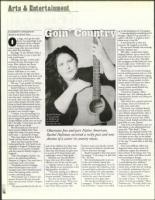
Observant Jew and part Native American,
Rachel Pashman survived a rocky past and now
dreams of a career in country music.
tody of the children, but Mary took
her two daughters and left the state.
After they were found, the girls went
to a series of 13 foster homes and
orphanages, none of them good.
(Pashman says she still doesn't
know why none of her relatives
offered to care for her and her sister
— "nobody wanted to take us" — or
why officials never returned her to her
legal guardian, her father.)
"They kept moving us to different
homes because they didn't want us to
become attached," Pashman says.
Not that she found much that
made her want to stay. "They were
not providing what I needed," she
says of her foster parents. She
believes many were hostile toward
her because of both her Jewish and
Native American heritage.
Rachel managed to find some peace
by singing. "I was using it to deal with
life," she says.
She wanted desperately to get out
of the cycle of foster homes into
which she was being placed. So at 16,
Rachel married. She worked as a wait-
ress and helped a physician at his clin-
ic. Her husband was a photographer
she'd met on the job. They were mar-
ried for five years, then divorced.
Rachel was once again alone.
One day she wandered over to a
synagogue. "I'd had a difficult day,"
she remembers. "I guess I just ended
up in this parking lot of a synagogue.
I was seajching for something and I
thought, 'Maybe if I go and talk to a
rabbi it will help.' I needed to know
where to go in my life."
A man passed by at that very
moment. He stopped to say hello.
He was kind, friendly and nonjudg-
mental, Pashman says.
The rabbi, a Lubavitcher, began
helping Pashman "get in . touch with
my Jewish roots and discover what it
really means to be a Jew." She liked
the synagogue and the Lubavitch com-
munity right away: "It felt like I was
at home. At last I had the family I'd
never had."
Meanwhile, she worked managing
several medical practices and as a mid-
wife — but still dreamed of a singing
career. In 1990, Lubavitch friends told
her about a young student in chiro-
practic school. His name was Albert.
They also told Albert about a
young woman named Rachel they
wanted him to get to know.
"I heard her singing," Albert
Pashman says, "not realizing that she
was the person friends were telling me
I should meet."
They fell in love, married and lived
in Georgia, Texas and Colorado for
awhile, then made aliya.
The family now included Rachel
and Albert as well as Esther, Rachel's
niece (Rachel adopted Esther when it
became clear that her own mother,
Gail, could not care for her). While
living in Israel, Rachel and Albert also
gave birth to a son, Shmuel.
They lived in Hashamron, just out-
side Schem in the administered terri-
tories (the "West Bank"). There,
Rachel says, she regularly battled with
Arab terrorists (once, she says, she saw
two about to set a fire, so she dashed
out of her home and began screaming
at the men. "I scared them so bad they
ran away").
Even more difficult, Albert was
diagnosed with a brain tumor. He
underwent surgery that seemed to
have rid him of the disease, but "mis-
takes were made" and Albert was left
with neurological damage.
That they survived financially was
"a total blessing from HaShem,"
Rachel believes. She made a little
money here, a little there by working
as a midwife, performing a few con-
certs and as a practitioner of Native
American herbal medicine.
After 5 1/2 years in Israel, Albert
was ready to leave. "The situation
where we lived was unstable," Albert
Pashman says. "We really didn't want
to go to another area of Israel. And