

This Week
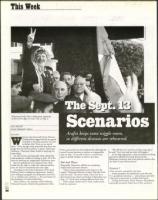
Palestinian leader Yasser Arafat greets supporters
in front of his office in Gaza City on Aug. 2.
GIL SEDAN
Jewish Telegraphic Agency
Jerusalem
henever the late Israeli Prime Minister
Yitzhak Rabin lagged behind an agreed
timetable in the peace process, he used
to declare that "there are no sacred
dates." Now, though using somewhat less direct lan-
guage than his former partner in peace, Palestinian
Authority Chairman Yasser Arafat is implying the
same thing.
On the record, and especially when addressing
Arab audiences, Arafat is sticking to Sept. 13 as the
date for declaring an independent Palestinian state.
But his spokesmen have explained that while
Arafat has the right to make the unilateral declara-
tion, he will not necessarily exert that right.
According to the latest evaluations of the Israel
Defense Force's intelligence department, Arafat is
now willing to postpone the declaration until Nov.
15, or perhaps even until Jan. 1, the anniversary of
the founding of Arafat's Fatah Party.
Salim Zanoun, the chairman of the Palestine
National Council, which is the parliament of the
8/11
2000
26
Arafat keeps some wiggle room,
so different dramas are rehearsed.
PLO, announced over the weekend that although the
council's recent decision to declare an independent
state on Sept. 13 was still in force, it would meet
again to decide whether to stick to that date.
Bob-And-Weave
Meanwhile, Palestinian officials are emulating
Arafat's bob-and-weave rhetoric.
"I hear various speculations and reports in the
media," Palestinian Minister of State Ziad Abu Ziad
said this week. "But from Arafat, I hear that he is
determined to go ahead and declare independence on
Sept. 13. I have heard nothing different from him."
When asked whether this is final, Arafat modi-
fied his statement.
"We still have one month until the target date,"
he said. "Let's wait and see what will happen."
As the date approaches, various scenarios are being
painted as officials from both Israel and the
Palestinian Authority deal with political realities after
the failed Camp David summit.
Scenario I
A first scenario, painted in rosy hues:
Arafat postpones the declaration until after the
U.S. presidential elections — and perhaps until after
a final peace agreement is reached with Israel.
During the summit, Prime Minister Ehud Barak
reportedly promised Arafat that if they reached a