

Facts On The Ground
In reality, Jerusalem already is under divided control.
ERIC SILVER
Israel Correspondent
Jerusalem
A
couple of Saturdays ago,
some American friends
called to say they were in
town. We invited them
over for drinks and a cold supper
in our garden on the Street of the
Prophets, two minutes from Zion
Square, the hub of west Jerusalem.
We had salmon and salad left over
from the night before, but we
needed nuts to go with the drinks,
and the last of the challa having
gone dry.
Like burst boilers or telephone
disconnections, these emergencies
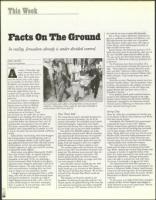
An Israeli border police oficer and plainclothes security personnel
always seem to strike on Shabbat.
confiscate a Palestinian vendor's goods for operating unlawfully in
The stores on the Jewish side of
east Jerusalems Old City on July 25.
town are closed, plumbers and
technicians are at the beach. There
One-Third Arab
are no buses on the roads. But no sweat.
Jerusalem is not sleeping. Not all of it, anyway.
The Camp David summit ultimately foundered on
I walked down the hill toward the Old City,
the issue of control of Jerusalem. Yet, for all the
turned left before the Damascus Gate, and 10
mantras of Jerusalem "the undivided, eternal capital
minutes after leaving home I was on Salah ed-
of the Jewish people," reiterated by every Israeli
Din Street, named for Saladdin, the Saracen
leader from the Six-Day War to the peace talks of the
chieftain who vanquished the Crusaders in 1187.
last two weeks, the city has never been monolithic.
I was in the same city, but had entered a different
One-third of its 600,000 residents are Arabs,
who stubbornly rejected Israel's offer of citizenship
world.
Salah ed-Din was bustling with Arab shoppers:
and smarted under the bureaucracy of occupation.
the young women in everything from jeans, T-
They kept their Jordanian passports, taught the
shirts- and designer shades to the ankle-length
Jordanian school curriculum, spoke their own lan-
gray gabardine dresses and white silk head scarves
guage, lived and shopped in their own neighbor-
of the Islamic revival, the men smoking heady
hoods (though many of them worked in ours).
Turkish cigarettes in safari suits and the occasion-
The concrete sniper walls and barbed wire came
al chequered Arafat keiyeh.
down in June 1967, but Jerusalem remained a bina-
Music stores were ghetto-blasting the Middle
tional city. The divisions were cemented when the
East rock of Amer Diab. An ageless shoeshine
Intifada (uprising) erupted in December 1987.
man, who has been there since I moved to
Israelis stayed away from the Old City bazaar,
Jerusalem in the early 1970s, was polishing a
shunned Salah ed-Din Street, no longer took their
local businessman's black Oxfords on his gleam-
cars to be painted in Wadi el-Joz.
ing brass stand. Streamers advertised a festival of
Since the daily violence receded after the 1993
Palestinian theater. The only Israelis to be seen
Oslo accords, tensions have relaxed. The more
were stray policemen, minding their own busi-
hardy Israelis go to eat hummus at Abu Shoukry's
ness so long as no one caused any trouble.
cafe. But most still keep their distance. We are here,
I bought peanuts and pistachios from a coffee
as Israeli Prime Minister Ehud Barak would say,
shop, rich with the scent of fresh-roasting beans
they are there.
and ground cardamom. I picked up a bag of
The expansion of 10 Jewish suburbs in east
bagel-shaped sesame-seed rolls, with a twist of
Jerusalem, the planting of nationalist yeshivas in the
Muslim quarter, the gradual blurring of the seam that
zdata (dried hyssop) in old Arabic newspaper,
from a couple of 12-year-old boys with a stall.
once separated communities, has made it impossible
Our guests would not go hungry.
to return to the pre-1967 partition of the city. Even
8/4
2000
20
the Arabs do not want ro reerect the barricades.
But as Yasser Arafat's Palestinian Authority has
grown in confidence, boldness and defiance, a par-
allel administration has taken root in Jerusalem.
Faisal Husseini, Arafat's point man, still reigns in
Orient House, which fanfaring governments of
right and left tried to close.
Jamil. Othman, the Palestinian governor of Al-
Quds (the Arab name for Jerusalem), takes care of
the city's 200,000 Arabs from his office in Abu
Dis, just across the West Bank border. His flock
voted for the Palestinian Authority president and
parliament.
The Palestinians have their own police, who
patrol in civilian clothes and keep their guns out of
sight. "They make their presence known in every
street and alley," Palestinian affairs reporter Roni
Shaked wrote in the mass-circulation Hebrew daily
Yediot Aharonot. "They handle drug wars, thefts,
everything."
From time to time, Palestinian security men have
detained "trouble-makers," like the journalist Maher
el-Alami, who protested at the rampant corruption
of Arafat's administration, or the civil rights cam-
paigner Bassem Eid, and spirit them to jail in
Ramallah or Jericho.
If my gardener, Jamil, needs medical treatment,
he goes to the Makkassed Hospital on the ridge
between Mount Scopus and the Mount of Olives.
Makkassed is managed by the Palestinian Health
Ministry. Jamil's children go to Palestinian schools
'under minimal Israeli supervision.
Strong Grip
Above all, Arafat has consolidated the Muslim grip
on the Haram el-Sharif, where Solomon and Herod
built their Jewish temples.
Immediately after Mordechai Gues paratroopers
conquered the mount in June 1967, Defense
Minister Moshe Dayan ordered his jubilant troops
to take down the Star of David flag they had raised
over AI Aqsa mosque, Islam's third most sacred
shrine. Dayan didn't want a holy war with the entire
Muslim world. Successive Israeli governments have
preserved the "status quo" under which Jews may
visit the mount, but not pray there, and the Islamic
waqf (charitable trust) controls the mosques.
The waqf used to be subordinate to Jordan,
which paid the salaries and maintained the build-
ings. Barely a decade ago, the late King Hussein sold
a mansion in London to regild the Dome of the
Rock. But Arafat appointed his own mufti and soon
eclipsed the Hashemites. Although Israeli police
reserve the right to maintain law and order there,
the mount is increasingly a no-go_ area for Israel.
The Palestinians have built what amounts to a
third, underground mosque in an archaeological site
known as Solomon's Stables. Despite Israeli protests,
tractors are still removing rocks, soil and potentially
priceless historical remains from the mount. Neither
Netanyahu's nor Barak's administration dared to
intervene.
On the mount, as in Salah ed-Din Street, Jerusalem
is already divided. As Roni Shaked acknowledged in
Yediot Acharonot on the eve of Camp David, "only the
details remain to be finalized."