
•,.
Local news directors reply to
charges of excessive dramatization
in TV news coverage.
A
consensus of comments from current and for-
mer local television news executives takes issue
with author Matthew R. Kerbers criticisms of
TV news in If It Bleeds, It Leads: An Anatomy
of Television News. They join Channel 7 News Director
Al Upchurch in the defense of TV news.
Mort Meisner, of Mort Meisner Associates in
Huntington Woods, said Kerbel can't pass himself off as
an expert on the subject of news broadcasting because he
hardly ever worked in TV news.
Meisner spent 23 years in the field, including stints at
the ABC and CBS networks, and locally as assignment
manager at Channel 7 and news director at Channel 2.
He currently is a TV consultant, lecturer
and agent for about 200 TV personalities.
He does agree with Kerbel that all of
the TV news decisions are based on rat-
ings. "It's a business," he said "The No. 1
reason for the existence of TV news is to
make money, so of course it's all done for
ratings. And if you don't get good rat-
ings, you get fired. It's as simple as that.
"As for the stories that 'bleed' (crime
stories), they have to be covered because
most of the viewers want to be titillated,
and they get their kicks from stories that
include violence. The people who watch
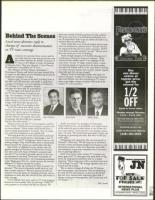
Mort Meisner
the garbage talk shows like Jerry Springer
also love the crime stories."
Meisner points out that TV news programs could be
better if they would devote more resources to stories that
are more relevant. "Many stories could benefit from a
more in-depth presentation," he noted, "but, of course,
you need more manpower to accomplish this.
"Devoting less time to crime and accidents and more
time to relevancy would require a big change in the TV
news formats, and TV management doesn't want to risk
making changes. They would rather stick to the formula
format because the viewers are comfortable with that."
Alan Frank, an Oakland County resident who was
general manager of Channel 4 in Detroit for 12 years,
also takes issue with many of Kerbers viewpoints and
says that TV news doesn't generally operate in the man-
ner described in the book. Frank now is president of
Post-Newsweek Stations Inc., the broadcasting subsidiary
of the Washington Post Co., which operates six network-
affiliated TV stations around the country.
"We don't make up or distort the facts of a story," he
declared. "The viewers ultimately would catch on, and
they wouldn't tolerate it. We have discussions with our
reporters every day about the handling of stories, and we
emphasize to them that they should be fair and honest in
their coverage.
"I can't defend every tactic used on TV news programs
because no one is perfect. But, by and large, I think TV
news operates in an ethical and efficient manner. We
don't wait outside of homes and burst in with cameras.
We obtain interviews in a professional and polite man-
ner. If people don't want to go on camera and talk to us,
we leave them out of the story."
Frank would like to see the local stations devote more
time and resources to national stories, "but the time fac-
tor requires that the local news items come first. All TV
news shows are locally oriented," he said. "We just don't
have the resources to cover everything."
Frank strongly disagrees with Kerbel's description of
weathercasts as being too long and irrelevant. "Many
viewers feel the weather report is the highlight of the
news show," he said. "A longer weather report is neces-
sary because people are interested in the local weather
and what the weather will be in the areas they're traveling
to. I know of some stations that cut their weather reports
drastically and their ratings plunged."
Walter P Kraft of Farmington Hills, who spent 19
years at Channel 7 locally, five of them as news director,
sides with Kerbel's view that everything on TV news is
done to get higher ratings and agrees with most of the
author's TV news criticisms.
11111111111111111111111
Buy
one dinner
entrée at
regular price,
get the
second for
1/2
OFF
Equal or lesser value.
Monday through Thursday
4 p.m. - 9 p.m. only.
Alan Frank
Walter Kra
Not valid with any other offer.
Must present ad when ordering dinner.
Kraft, now senior vice president of Caponigro
Public Relations Inc., in Southfield, even regrets many
of the orders he gave to news crews to use various tac-
tics to get stories, "and I now see I was wrong in many
ways," he said. "We could always rationalize a tricky way
of getting or presenting the news. But what we did just
wasn't right."
Disagreeing with Upchurch, who now has his job at
Channel 7, Kraft said, "We did camp out at the homes
of crime victims and disrupt people's lives because it was
absolutely necessary to the story. Reporters were told it
was mandatory to get those comments, but it's an intru-
sion on grieving relatives."
Kraft, who says he rarely watches TV newscasts any-
more, agrees that TV news gives only short shrift to big
stories by using quick sound bites and no in-depth
reporting. "The average story with an anchor's voice-over
is 20 seconds," he said. "The average reporter's story is a
minute and 30 seconds.
"But in order to change all of this, the TV stations
need more people, more resources. They are hamstrung
by a lack of time and resources, so they just do the best
they can. It's a vicious circle, requiring a great deal of
change on the part of management, and I doubt that will
ever happen." ❑
Southfield location only.
29244 Northwestern Highway
(248) 351-2925
— Bill Carroll
372 Oullette Avenue • Windsor, Canada
Scanned image of the page. Keyboard directions: use + to zoom in, - to zoom out, arrow keys to pan inside the viewer.
August 04, 2000 - Image 111
- Resource type:
- Text
- Publication:
- The Detroit Jewish News, 2000-08-04
Disclaimer: Computer generated plain text may have errors. Read more about this.